
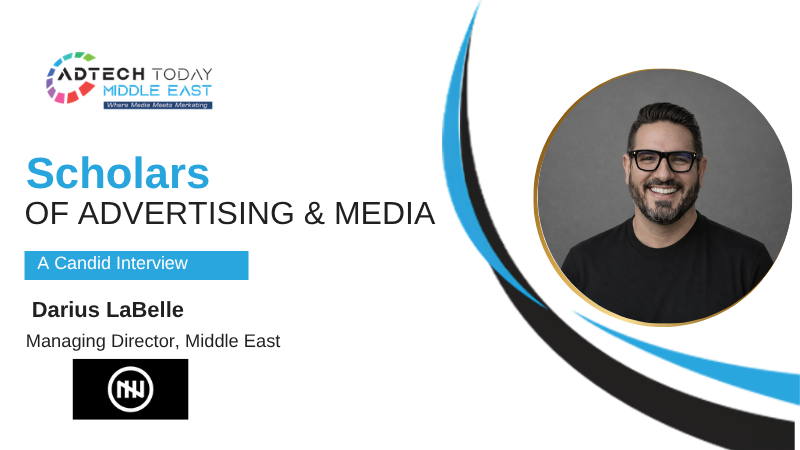
Darius LaBelle has spent twenty years building digital products that people actually want to use. Now the Managing Director, Middle East at November Five, he has seen the industry from every possible angle- from scaling new ventures in New York to navigating the massive machinery of global networks.
He is known for a grounded, clear-eyed approach to his work and prefers to focus on the real-world substance of a project rather than the hype that often surrounds it. He looks specifically for the gap between what a data point sees and what a person actually feels. Darius is a firm believer that technology should handle the boring, repetitive tasks so there is more room for the “human magic” that makes a brand stick.
In this conversation, he explains why the Middle East is the perfect place to stop building for “average” users and start building for real human motivations.
You’ve moved between global networks, scaling new propositions in New York, and now an independent studio in the Middle East. What’s the throughline in those decisions?
Every move I’ve made has been toward wherever the gap was most interesting and most consequential. Global networks are a great starting point because of their scale and their clients; they have true rigour. But the financial model of a network creates a ceiling; overheads must be passed on, and structures make experimentation expensive. That produces solid, repeatable work. But it also means it is much harder to create an agency product at the leading edge, as that edge keeps changing.
Independent agencies operate differently without the burden of a global cost base; you can take genuine risks on the model and try things that don’t fit a standard rate card. You can build ways of working that a network would spend a year just getting approved.
The Middle East is where both of those lessons matter most right now. Customer expectations here are moving faster than almost anywhere else.
“The gap between what people expect from a digital product and what most enterprises are delivering is still significant.”
That’s where the most interesting work is; it’s exactly why I’m here.
After years across Asia, North America, and the Gulf, what does the Middle East do better than other markets when it comes to brand and customer experience?
The bias to action here is real; it is accelerating. CMOs and CXOs are increasingly operating toward direct commercial outcomes rather than leading pure brand functions; that shift is driven by how the roles themselves are evolving. Fewer than half of Fortune 500 marketing leaders now hold the traditional CMO title. Many operate as Chief Growth, Customer, or Commercial Officers; these titles signal direct accountability for revenue rather than brand stewardship¹. In the Gulf, this plays out faster because the organisations themselves are moving faster.
Then there is the scale of ambition. Brands in this region have a starting expectation to be world-class from day one. Few markets open the conversation with that bar already in place. What is less resolved is the intersection of brand, experience, and technology. The large tech integrators can execute at scale, but the experience thinking is thin; conversely, agency networks see enterprise work as a way to capture revenue from consultancies, so they aren’t geared for true product work.
A true specialist studio built around that intersection of brand and tech is exactly what this market needs. And the market knows it.
“What the Middle East does better than most is recognise the gap, name it clearly, and find the thing that will close it.”
Read more: November Five Expands to Middle East with AI-Driven Product Studio Model
In a region rapidly adopting the super-app model, how do you ensure a digital product becomes a lasting competitive advantage for a brand?
Most digital products in the super-app era are built against behaviour; they focus on what users do today, what the data shows, or what the competitor just shipped. The problem is that behaviour is a lagging indicator; it tells you what happened, not why people chose it or if they would actually miss it if it disappeared. Because data aggregates, it often builds for the “average” user; that usually means it builds for no one in particular.
The products that become lasting competitive advantages are built against motivation. That is the foundation of Memorable Experience (MX™), our methodology at November Five. MX™ requires thinking beyond features; it layers customer motivation, journey design, and brand promise into a single system.
“Most organisations skip that work because sprints do not have a line item for ‘meaning.’ The resulting products feel functional, but they are forgettable and feature-led.”
In the super-app context, the risk is that brands chase feature parity without building a reason to be chosen. The switching costs that once protected digital products are eroding; what replaces them is a product people have a genuine relationship with.
Gulf AI adoption is ahead of global averages. What does the next stage of that journey look like as it matures into full business impact?
The first wave of AI adoption was largely about proof of concept and efficiency; it was about pilots, demos, and cost reduction. That phase produced real momentum but also a fair amount of overclaiming; in some cases, quality was the thing that got traded away. That is not unique to this market.
The next stage is the move from AI as a feature looking for a benefit to AI as a tool that builds genuine business and customer value. A lot of organisations are still asking which AI tool to use and which stack to adopt; however, the question that determines business impact is whether the data layer is ready to power it. That is the gap we encounter most consistently with enterprise clients; it is the one problem that no amount of tooling solves.
What separates the organisations that will see real returns is treating AI as an operating model question rather than a technology question. That means embedding it into how decisions get made and how products get built across research, design, and delivery. The tooling is increasingly commoditised.
“The competitive gap will belong to whoever builds the right operating model around it and grounds it in data that is fit for purpose.”
You’ve led inside global networks and now an independent studio. What does each model do that the other simply can’t?
Global networks have real strengths; they offer institutional knowledge and the ability to mobilise across disciplines and geographies. For a certain category of work, that system is very valuable. The challenge is that the commercial model often shapes the output; digital teams inside networks are frequently briefed against existing revenue expectations rather than what would make the work genuinely better.
The independent model removes that constraint. The senior people you meet are the ones actually building the product. There are no overhead layers between the thinking and the execution; this means judgment stays present all the way through the process. That is a consistent frustration clients report; the team that wins the business and the team that delivers it are frequently not the same people. The brief gets answered more cleanly too.
“Networks often cross-sell their suite of services to fund global infrastructure; with an independent, the commercial interest is tied solely to the outcome. This produces more honest counsel.”
Independence also enables adaptability; we can adjust our structure or try a different approach mid-engagement based on what the work actually needs. The decisions we make are simply what is right for the work.
With internet penetration close to 99% in the UAE, the challenge is no longer reach but relevance. What does personalisation at scale genuinely require to deliver on its promise?
Personalisation at scale has a technical answer and a more important strategic one; the technical side requires first-party data, clean architecture, and the infrastructure to act on signals in the moment. Most organisations in the region are still building that foundation in the data layer. The phase-out of third-party cookies, combined with new privacy legislation, has forced a pivot toward first-party strategies; that work is well underway.
However, the strategic problem runs deeper. The sophistication we see in omni-channel media planning hasn’t yet filtered into digital products; most programmes are still built on surface-level demographics. They know roughly who you are and what you have done, but they don’t know why.
A customer who bought travel insurance last March isn’t just a category of buyer; they were going somewhere. It might have been a first trip abroad with young children, a long-delayed honeymoon, or an ageing parent being taken to see family. The product was incidental to all of that. What they want lives in that context and not in the purchase history. Unfortunately, most personalisation engines see the transaction while the motivation remains invisible to them. In a region where personal milestones, family occasions, and cultural moments carry enormous weight, the brands that learn to read that layer will create real distance from the competition.
“Personalisation that operates at the motivational level is what creates a materially different experience.”
When it works, the outcome is a product that feels built specifically for that person; that feeling is what drives the metrics that matter: retention, advocacy, and lifetime value.

- Embedded Finance Is a Marketing Decision, Not a Banking One - October 7, 2026
- EMIR and Omnicom Media MENA Partner to Amplify GCC Thought Leadership - September 9, 2026
- We Are Now Using AI To Fire Customers For Our Own Bugs - September 8, 2026