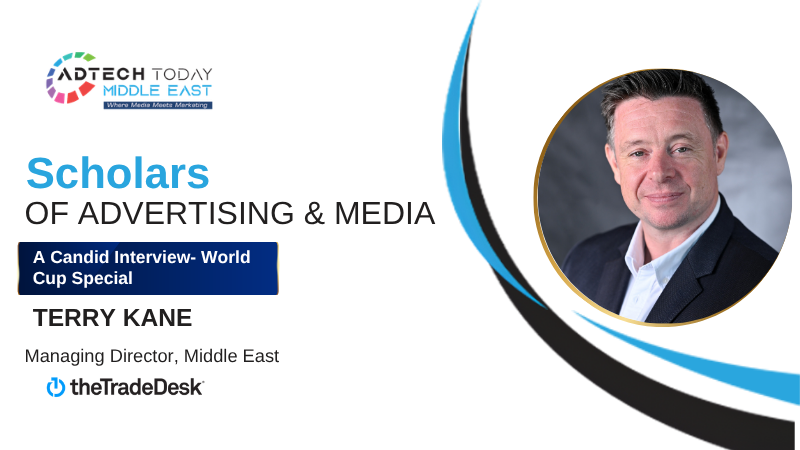
Terry Kane is a seasoned veteran of the Middle East’s digital landscape with two decades of experience. As the Managing Director for the region at The Trade Desk, he’s seen plenty of industry shifts, but none quite as fast as the way GCC fans are now following sports. With the World Cup on the horizon, the old rules of TV advertising are being tossed out. The fans in the UAE and Saudi Arabia are now living the game across their phones, their cars, and their living rooms all at once.
In an exclusive conversation, Terry explains why the old-school idea of the “90-minute match” is effectively over. He gives us a glimpse into the new data reshaping the region; he explains why the real win for brands isn’t just a logo on a screen, but staying relevant from the morning commute to the final whistle.
The research shows GCC fans are moving across CTV, audio, DOOH and mobile throughout the fan journey. How has this changed the way brands need to show up around live sport?
What’s fundamentally changed is that live sport is no longer a single-screen, single-moment experience. Fans in the GCC are moving fluidly across CTV, mobile, audio, and DOOH throughout the entire day, not just during the match.
For brands, that shifts planning from single-moment sponsorships to connected, full fan-journey strategies. The opportunity is to build sequential storytelling that adapts to attention as it moves: pre-match anticipation on mobile, live immersion on CTV, and real-world reinforcement through DOOH.
Programmatic technology is what makes this workable at scale, ensuring consistency, frequency control, and relevance without overwhelming audiences. With identity, measurement, and omni-channel planning, brands can stay present across the journey rather than just the moment.
“The takeaway is simple: follow the fan, not the format.”
With 82% CTV penetration in the UAE, and four in five Saudi fans saying it makes sport more immersive. How should brands be structuring their CTV strategy specifically for live sports moments?
CTV in the Middle East has evolved into a premium, high-attention environment where quality matters as much as reach. For sports, particularly football in Saudi Arabia, viewing is year-round, peaking around key fixtures and moments.
Brands should prioritise premium, brand-safe environments that are live or near-live, where emotional engagement is highest. Rather than thinking in demographic segments, the focus should be on intent and viewing context.
“CTV should also not operate in isolation.”
It works best as the anchor of a converged video strategy, connected to mobile, audio, and DOOH to extend impact beyond the screen. Within The Trade Desk, advertisers can unify these touchpoints and move beyond traditional linear TV buying into a more flexible, data-driven ecosystem built around real audience behaviour.
Read more: The Fan Has Moved. Has Your Media Strategy?
Audio and DOOH are emerging as powerful companion channels in the region. How do brands practically connect these touchpoints into one coherent campaign?
“Audio and DOOH are powerful precisely because they operate in context-rich, real-world moments, but their impact increases significantly when they are orchestrated together.”
The key is alignment through shared audience signals and data signals. DOOH delivers scale and visual impact in high-traffic environments, while audio provides intimacy and continuity during moments like commuting or gym time.
Creatively, they should play distinct but complementary roles. Programmatic enables sequencing, frequency control, and ensures the same audience is coherently reached across both environments.
Ultimately, it’s about targeting people, not places. With the right data infrastructure, brands can connect these channels into a unified journey that feels seamless rather than fragmented. Audio, in particular, is enormously powerful and easy to enable. Yet, it remains underutilised in the region, and the opportunity window is now before demand and pricing rise.
Nine in ten Saudi fans stay engaged with sport beyond tournament periods. What does a year-round sports marketing strategy look like for brands in this market?
One of the clearest insights from our data is that fandom is always on: Fans engage before, during and long after the game, not just on matchday, especially in Saudi Arabia. This region is mad about sports.
That means brands need to shift from short-term bursts of activity to sustained audience-building strategies. The World Cup should be treated as a peak moment, not the whole strategy.
“Non-tournament periods are especially valuable for testing creative formats, refining messaging, and building a deeper understanding of the audience without the pressure of live-event competition.”
This is where always-on planning becomes critical in maintaining presence, learning from engagement signals, and optimising over time. Fans are everywhere. The Trade Desk connects brands to fans in the moments that matter across premium digital touchpoints.
Programmatic has opened the door for non-sponsors to compete for fan attention. What’s your advice for regional brands without an official World Cup deal?
Not being an official sponsor is no longer a barrier to relevance. Programmatic has fundamentally democratised access to premium sports audiences. The focus should shift away from official rights or assets, and towards the fan mindset. Fans care about content, context, and relevance, not whether a brand holds a sponsorship badge.
“Using real-time signals, contextual alignment, and culturally relevant creative, non-sponsor brands can still show up meaningfully across the fan journey.”
In many cases, smart, fan-first creativity can outperform official sponsorships. The ability to adjust messaging in real time, align with live moments, and optimise based on performance creates a competitive edge.
The opportunity is significant: brands that think fan-first, rather than rights-first, can play a meaningful role in the World Cup community.
As the World Cup approaches, what’s the one shift in advertiser mindset you’d most want to see across the GCC?
“The biggest shift required is moving from buying media around sport to building relationships with fans through sport.”
That means letting data, not legacy TV norms, guide how campaigns are structured. It also means recognising that attention is fragmented across premium digital environments instead of concentrated in a single channel.
Social media often dominates digital advertising conversations, but it is not where audiences spend most of their time in markets like Saudi Arabia and the UAE. Brands need to realise this and break from the dopamine of social media. Equally important is embracing experimentation, testing across channels, formats, and moments, then optimising based on real outcomes rather than assumptions.
Ultimately, success should be measured beyond reach: in attention, engagement quality, and long-term brand value. The Trade is the only real tech platform that offers a transparent and reliable source of what works for your brand and bottom line.

- ChatGPT Ads Are Live in MENA. The Benchmarks Aren’t Yet - October 21, 2026
- Embedded Finance Is a Marketing Decision, Not a Banking One - October 7, 2026
- EMIR and Omnicom Media MENA Partner to Amplify GCC Thought Leadership - September 9, 2026