

The stadium was never just a place. It was a feeling — the roar of a crowd, the shared tension of a penalty, the collective exhale after a goal. For decades, brands chased that feeling through a single screen in a single moment. Sponsorship banners. Halftime slots. Broadcast deals.
What was once a single screen, a single moment, is now a dynamic and continuous experience across connected TV, streaming audio, mobile and digital out-of-home. For brands across the GCC, the 2026 World Cup is not just a sporting event. It is a test of whether their media strategies have kept pace.
New research commissioned by The Trade Desk and conducted by PA Consulting, based on a survey of 2,800+ sports fans, shows the omnichannel fan is already here.
The GCC Opportunity Is Significant
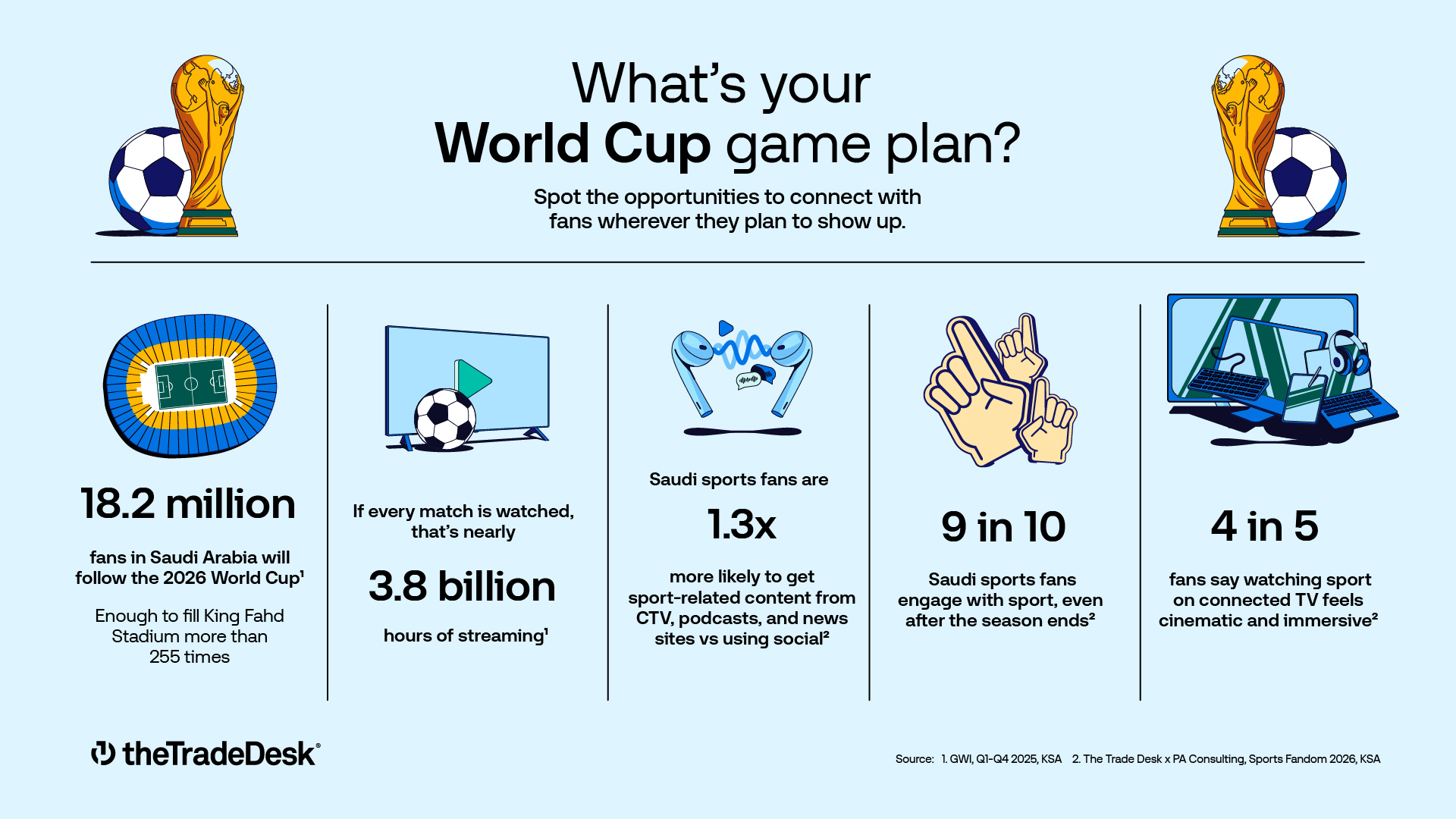
Live sports viewership stands at 84% in the UAE and 81% in Saudi Arabia. In Saudi Arabia alone, 18.2 million fans are expected to follow the 2026 World Cup — enough to fill King Fahd Stadium more than 255 times. If every match were watched in full, that amounts to nearly 3.8 billion hours of streaming content, equivalent to more than 431,000 years of viewing time.
But the real value lies in how audiences engage, not just how many there are. Saudi sports fans are 1.3 times more likely to use connected digital channels over social media, signalling a clear shift toward premium, cross-platform viewing. Nine in ten Saudi sports fans also remain engaged with sport outside tournament periods, giving brands a sustained window well beyond the 64 matches.
Read more: Built for the Long Run: Terry Kane on AdTech, Retail Data and MENA’s Next Phase
CTV, Audio and DOOH Are Driving the Shift
Three channels are reshaping how fans experience sport across the region.
CTV penetration in the UAE sits at 82%. Four in five Saudi sports fans say CTV makes watching sport feel more cinematic and immersive, reinforcing its role as the anchor of live sports engagement. It gives fans the flexibility to watch live or catch up later, while offering brands a high-attention, emotionally invested audience in a premium environment.
Digital audio and podcasts extend fan engagement off-screen entirely. Omnichannel campaigns incorporating streaming audio can reach 18 million+ sports fans across the UAE and Saudi Arabia combined, connecting with audiences during commutes, workouts and everyday moments when emotional connection to sport remains high.
DOOH is emerging as a critical layer, particularly in Saudi Arabia, taking fan experiences beyond the home into malls, transit hubs and entertainment districts. It builds shared momentum around major events and reinforces messaging already delivered through digital channels.
The Full Fan Journey — Before, During and After
83% of sports fans say connected digital channels are central to how they experience sport. 89% continue moving across channels throughout the fan journey. Brands that plan only for the live moment are missing the majority of it.
- Pre-tournament: Build awareness and anticipation through CTV and audio when fans are in discovery mode
- During live moments: Capture high-intent audiences across CTV and DOOH simultaneously
- Post-match: Sustain engagement through audio, mobile and digital environments where fans continue to follow the conversation
You Don’t Need a Sponsorship Deal
Official sponsorship is no longer a prerequisite for relevance. Programmatic advertising now allows brands without World Cup status to compete through contextual targeting, agile media buying and measurable omnichannel campaigns. Regional players including Qatar Airways, Saudi Aramco and Visit Saudi have already demonstrated what is possible on a global sporting stage.
Fandom is deliberate, dedicated and always on. Advertising around the World Cup needs to be too.
Research commissioned by The Trade Desk, conducted by PA Consulting. Survey of 2,800+ sports fans across the UK, France, Germany, Spain, Italy and Saudi Arabia. World Cup data in partnership with Appinio.