
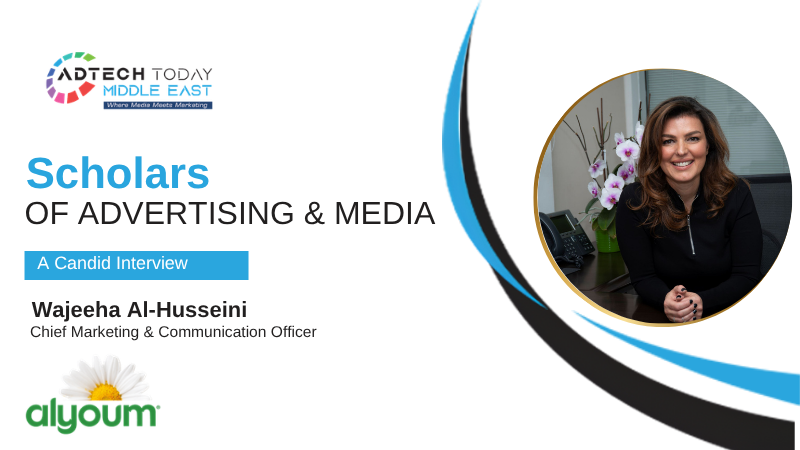
Wajeeha Al-Husseini doesn’t just analyze markets; she feels their rhythm. As the Chief Marketing & Communication Officer at Alyoum, she brings a formidable blend of Ironman-level discipline and intuitive storytelling to the C-suite. With years of high-stakes experience across the MENA region, Wajeeha has become a resilient advocate for the “human magic” that no algorithm can replicate. She is a leader who consistently chooses bravery over technical perfection and substance over fleeting digital trends. In this conversation, Wajeeha reveals why the most powerful tool in a marketer’s arsenal isn’t a spreadsheet; it is the courage to truly listen.
You describe your upbringing as a rich cultural hybrid bridging East and West. How has this vantage point fueled your approach to global brand storytelling?
I am Palestinian-Jordanian. That’s where this story starts — in a culture built on resilience, hospitality, and a deep sense of belonging. But I also grew up exposed to Western education and global ways of thinking, and honestly, that pull between those two worlds is the most valuable thing I carry into my every day.
I learned never to assume. Stories are varied and there is no such thing as one size fits all.
“When I sit down to shape a brand’s voice, I take extra care to look at the 98% and not the 2%.”
And that starts with understanding and knowing that how I grew up is NOT what the other 98% have experienced. So I start by listening; I mean really listening to how people actually experience their lives, food, and daily rituals. In this region, while we value culture and tradition, we are not afraid to also embrace the new.
At Alyoum, we try to honor that.Our products are rooted in heritage; the flavors, the recipes, and that essential sense that food is how families connect. But the way we show up, our packaging and our communication, it feels modern and confident with a massive focus on quality I think the brands that truly resonate in this region are the ones that don’t fake their way to people’s hearts. They value the past yet also bring the future to the present.
You recently prioritized agility and creativity over pure technical skill. How do you cultivate these entrepreneurial instincts in teams to outpace market disruption?
“I would rather hire someone who is curious and brave than someone who is technically perfect but waits to be told what to do.”
Skills can be taught. Instinct, the ability to see an opportunity and move towards it, is so much harder to build from scratch.
What I try to do is give people real ownership. Not just tasks, but actual accountability for outcomes. When someone owns a campaign or a trade activation end to end, they think differently. They stop asking for permission and start asking better questions. That’s when everything changes and real creativity, ownership and belonging comes to light.
I also encourage my team to be in the market — stores, trade reviews, conversations with suppliers. Not because that is their job description, but because the best marketing ideas come from people who understand the whole picture, not just the brief in front of them. It’s not words on paper. It is real world experience.
“Disruption is not about being the first to adopt a new tool. It is about being the team that connects things others do not see.”
My role is to create the space where that happens naturally.
As Alyoum’s CMO, you advocate for leading through creation. How do you balance this intuitive, human-centric leadership with the ruthless data demands of today’s FMCG sector?
Data and intuition need each other.
Data is brilliant at showing us what happened — where sales dipped, which promotions worked, how consumers moved through a category. But it cannot tell us what to create next. It cannot feel the mood of a market or sense when a brand’s tone is slightly off. That part is human, and we should protect that fiercely.
Dashboards should never replace the conversations. The most important question in any room is still “does this feel right?” and no spreadsheet can answer that for you.
What I have learned is that data’s greatest gift is not direction; it is confidence. It will support killing any bad ideas early so teams can pour their energy into the ideas that actually matter.
“The brands people love are not built by algorithms but rather by people who care deeply and think carefully, and who use data as a compass, not a cage.”
Having operated across diverse MENA markets, how do you navigate the friction between preserving localized heritage and embracing rapid digital modernization?
The best ideas and work come from actually being at the center of both tradition and modernization.
“Heritage is not nostalgia; it is a real commercial advantage that no global brand can manufacture.”
The emotional connection people have to traditional recipes, to regional flavors, and to the way their grandmother made something; it is ours, and we should protect it.
But protecting it does not mean freezing it in time. At Alyoum, we work hard to keep the soul of our products intact while making sure the experience around them feels current. That applies to how we show up online, how the packaging communicates on a digital shelf, and how we engage with younger consumers who discover brands through content rather than commercials.
What I don’t like is the pressure to digitize for the sake of it. Not everything needs to be an app or a campaign. Sometimes a beautifully executed in-store moment, built around a story that means something, will outperform anything digital. The real skill is knowing when to use which tool, and having the confidence to choose substance over a fleeting trend. But there are also budget considerations and sometimes, you are forced to do just the opposite of what you believe.
The right thing to do is pick that one moment where you can bring at least one activation to life that isn’t built around trends but real story telling. Stay tuned!
As AI redefines expectations, where are the untapped growth opportunities for purpose-driven brands regionally?
The biggest opportunity is being able to be genuinely relevant to people at a level of detail that was not possible before.
“AI helps us get to the nitty gritty and can be used to help us create communication from real experiences be it local dialect, seasonal traditions, or celebrated occasions that matter in their community. “
For food brands, there is also a practical opportunity. AI can help us plan demand more accurately, reduce waste, optimize what we put on which shelf in which neighborhood.
But here is where I feel strongly: AI should never become the voice of a brand. People are perceptive. They will welcome a brand that uses technology to serve them better, but they will walk away from one that feels like it replaced humans with machines. You can’t get past that.
Drawing from your Ironman triathlon discipline, how does an endurance mindset translate into sustaining brand vitality during economic turbulence?
Endurance sport teaches you something very simple that most people forget in business: the hardest part is not the start. It is the middle — when you are tired, when conditions get difficult, and when every part of you wants to just stop.
The pressure to cut marketing budgets, to chase short-term volume through heavy discounting, to retreat from the investments that build long-term brand strength —is enormous. And I understand why people give in to it. But I have seen, again and again, that the brands which hold their own during downturns are the ones that come out ahead when things recover.
“The brands that survive turbulence are not the ones that panicked least; they are the ones that believed most.”
My approach comes down to three things.
First, pace yourself; protect brand investment even when the pressure to redirect everything into promotions is intense.
Second, stay visible ;when competitors go quiet, your share of voice becomes more efficient, not less.
Third, take care of your team; do not starve people of resources or ambition just because the market is difficult.