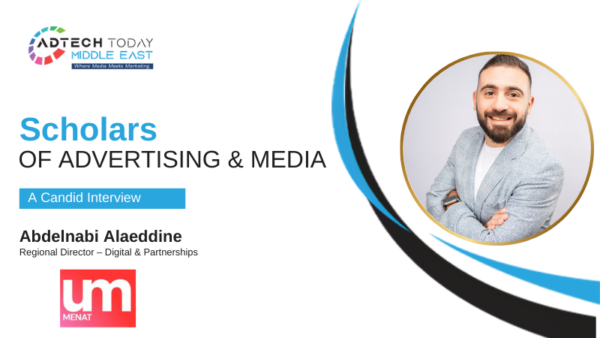


The most valuable ad space in the Gulf right now isn’t a screen, a billboard, or a scroll. It’s the handful of seconds between someone finishing a bottle of shampoo and reaching for the next one. Chirag Galundia, Senior Director of Media Solutions at talabat, one of the region’s largest quick-commerce platforms, says that reorder window, not the ad someone half-noticed an hour earlier, is where brands are actually winning or losing a customer.
In an exclusive conversation, he explains why that same instinct, reading the real signal over the obvious one, increasingly separates brands that understand customer intent from those that don’t.
talabat sees what people actually buy late at night, what they abandon, what they reorder without thinking. What does that data reveal about how this region really shops that the brands advertising with you haven’t yet figured out?
Quick commerce in the Gulf has grown into a genuinely large habit, not a niche one: the GCC market alone is on track to nearly triple in size over the next five years, and grocery and household staples already make up the majority of that basket. Most of it is also fast by design: the bulk of orders are landing inside a 30-minute window, which means shopping has compressed into a series of small, urgent moments rather than one planned weekly trip. What we sit on top of is the transaction and reorder data behind those moments – what someone buys on repeat, what they run out of and when, what they add on impulse. What most brands haven’t figured out is how to actually read those signals and let them shape when and where they show up, rather than just running the same campaign on a fixed schedule.
“The opportunity is to treat every reorder window as a micro-moment – a brief, high-intent pocket of time where a brand can be present right as the need resurfaces.”
Brands that are able to capture this rhythm are able to capture a higher LTV of a customer which is by far the most critical metric for a brand to track.
You’ve built retail media from both the agency and platform side. Looking back, what’s one belief you held as an agency partner that changed once you understood the platform economics?
Agency-side, the job was consultative: you’d understand the client’s objective, then build a funnel-led mix around it. Platform-side, the lens widens: you’re weighing that client’s overall commercial performance, growth versus category, and investment versus potential.The first belief that changed was inventory. Agency-side, one slot looked much like another if the audience was there. Platform-side, certain placements, like the top of a search result, are genuinely scarce and carry real value. That reframed margin for me: less negotiation, more pricing real estate.
The second was “no.” I used to see pushback as a technical limitation or protectionism. Now I see it as a platform managing the trade-off between monetisation and customer experience: tip too far toward monetisation and you degrade the very inventory that made it valuable.
“Some ‘nos’ were the platform protecting audience quality, because a cluttered experience lowers purchase intent for every brand on it, not just the one being told no.”
Brands invest in retail media because it sits closest to the sale. But where do you think a delivery platform adds the least value for a brand, and why?
I’d challenge the premise a little. Retail media isn’t only valuable because it sits closest to the sale: it’s a much wider part of how brands show up, not just the moment someone opens the app to buy or reorder.
As for where a delivery platform adds the least value, that’s subjective: it depends on the brand and category. Where we shine brightest is in conversion and immediacy. A brand’s long-form storytelling, building a narrative or shifting a perception through a longer video or documentary-style piece, is better suited elsewhere, since the shopper on our platform is in a different headspace.
But that’s exactly what makes this moment interesting. Quick commerce is changing buying behaviour in a way we haven’t seen before. Someone can see a brand on TV, on a billboard on the drive home, or scroll past it on Instagram, and within minutes actually have that product in their hands, because a dark store nearby had it ready. Retail media and delivery platforms are becoming the bridge that lets a customer act immediately on an ad they saw anywhere, turning exposure everywhere else into an actual purchase rather than waiting for the last click before checkout.
As AI assistants start making more of the actual buying decisions, the shopper may never see the ad at all. In that world, what is a brand really paying a commerce platform for?
AI agents changing how people shop is happening regardless of what any of us think about it. The real question is what a brand needs to do to stay relevant, discoverable, and buyable once the agent is doing the shopping and not the person. Once an agent is making the choice, the things it weighs – stock availability, competitive pricing, purchase history, what similar customers consistently pick – become the new advertising
surface.
“A brand isn’t paying for eyeballs in that setup; it’s paying to be well-represented in the data the agent actually trusts.”
The platforms holding the richest, most reliable transaction history end up mattering most, because their signals are what the agent leans on to decide. So the job shifts from getting seen to making sure the fundamentals – price, availability, repeat-purchase strength – hold up well enough to get picked.
Retail media is sold on precision and closed-loop proof. Being honest about where it stands today, what does the measurement still not capture well, and what would it take to fix?
We’re strong at tracking what happens in a single session: someone clicks a sponsored listing, adds it, checks out, and we can show you that clean path. Where the industry as a whole is still evolving is anything that plays out over days or across channels. A customer who buys after clicking one of our ads might well have bought anyway, and separating that from a true incremental sale is still more art than science across this industry, not just for us.
Cross-channel is the harder problem. A brand running campaigns with us, on social, and on TV at the same time will often get inflated credit claimed by each platform separately, and nobody’s fully solved how to net that into one accurate number. Closing that gap means platforms opening up to independent measurement rather than marking their own homework, and brands pushing for it even when the resulting numbers come in smaller than what’s currently reported.
Having built commerce in both India and the Gulf, what’s the one thing about the Gulf shopper that brands from bigger ecommerce markets consistently get wrong on day one?
The biggest misread is treating this as one homogenous, price-driven market because the population is smaller than India’s or other large ecommerce markets. It’s actually one of the most nationally diverse consumer bases you’ll find within a single city, and a creative that lands with one community can miss the next building completely. Brands from bigger, more uniform markets tend to build one campaign and assume it travels everywhere here. The second misread is around price. Shoppers here aren’t price-immune, but price is rarely why they pick one brand over another – convenience, familiarity, and how consistently a product shows up matter more.
“Lean too hard on discounting and you end up building a base that only shows up for the deal, which isn’t the same thing as loyalty.”
The brands that do well here usually got there by showing up reliably and investing in presence early, rather than trying to buy attention through promotions.