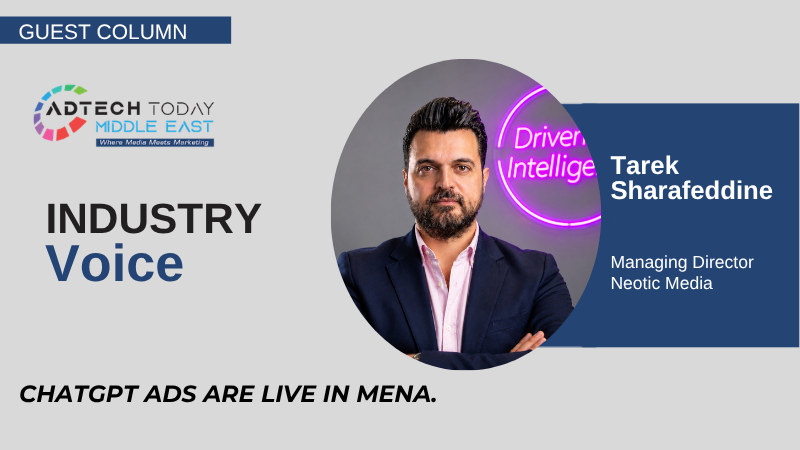
OpenAI opened self-service ChatGPT Ads across the region on 31 August. Tarek Sharafeddine, Managing Director, Neotic Media, argues that before agencies move a single budget line, they owe clients an honest account of what is proven and what is still a test.
ChatGPT Ads are now live across MENA, and the opportunity is real. But for agencies, the first conversation with clients shouldn’t be about how fast we can shift budget into the platform. It should be about how clearly we can explain what we know, what we don’t know yet, and how we plan to find out. That’s how trust is earned right now.
A Different Kind Of Consumer Moment
ChatGPT is a very different environment for consumers. People aren’t just scrolling through cntent or typing keywords into a search bar. They’re asking questions, researching products, comparing options and looking for recommendations, all within a conversation. That could put advertising much closer to the moment when people are actually making decisions.
OpenAI opened ChatGPT Ads across the Middle East and North Africa at the end of August, and says its advertising business has already reached a $1 billion annualised revenue run rate globally. Numbers like these naturally create excitement. But availability in a region doesn’t mean maturity in that region.
The Benchmark Gap
In MENA, we don’t yet have the depth of local benchmarks we’ve built up over years on search, social and programmatic. We don’t have reliable category benchmarks for click-through rates, conversion rates, cost per acquisition or incremental return in Saudi Arabia, the UAE or the wider region. And how people hold conversations in Arabic adds another layer, one we need to understand through real campaign data, not assumptions.
Tools Are Not Proof
Measurement is improving quickly. OpenAI’s Ads Manager currently reports impressions, clicks, spend, CTR, CPC, CPM and conversions. Advertisers can track conversions through its Pixel and Conversions API, and it has started working with third-party measurement partners. But having measurement tools is not the same as having proven measurement.
“Having measurement tools is not the same as having proven measurement.”
Agencies need to be clear about that difference, especially with large advertisers who already have established attribution models. The question isn’t just, “What ROAS did ChatGPT report?” It’s also: What does the client’s own analytics show? What happened to branded search? Did we bring in new customers, or just capture demand that already existed? How does the traffic quality compare with search and social?
The same thinking applies to brand safety. OpenAI says ads are kept separate from ChatGPT’s answers and don’t influence them. It says advertisers can’t see users’ private conversations, and its policies keep ads away from sensitive or brand-unsafe topics. These are important protections. But agencies still need to see how well they hold up in real campaigns, and especially within the cultural and language realities of this region.
Build Ways To Learn
That’s why I believe an agency’s job today is not to sell certainty that doesn’t yet exist. Instead, we should build controlled ways for clients to learn.
“An agency’s job today is not to sell certainty that doesn’t yet exist.”
Start with test budgets rather than pulling major investment away from proven channels. Set a clear hypothesis before launch. Agree on KPIs. Use independent tracking wherever possible. Compare the platform’s reported conversions with the client’s own analytics and CRM data. Look at the quality of traffic, not just the volume. And record what we learn by category, audience, language and market.
Let The Client’s Goals Decide
Most importantly, agencies should resist recommending ChatGPT Ads just because AI is the industry’s hottest topic. Innovation without accountability doesn’t build trust.
“Innovation without accountability doesn’t build trust.”
Clients expect us to spot new opportunities, but they also expect us to protect their money. Sometimes good leadership means encouraging a brand to test a new platform early. Sometimes it means advising another client to wait until measurement, inventory or brand-safety controls are more mature. The recommendation should come from the client’s business goals, not from the industry’s fear of missing out.
Over time, ChatGPT Ads could become a key part of the media mix, because conversations can bring brands closer to moments of real consumer intent. That’s especially interesting as the way people search and discover keeps changing.
But the agencies with the strongest client relationships won’t necessarily be the ones that move fastest. They’ll be the ones that are open about what’s proven, honest about what’s still experimental, disciplined in how they test, and willing to let the evidence decide where the next dollar goes.
Technology will keep changing. Our responsibility to clients shouldn’t. And in the end, that’s how trust is earned.
Tarek Sharafeddine is a seasoned media professional with over 20 years of experience across the region, with a strong focus on the Saudi Arabian market and an extensive track record of managing leading Saudi clients.
Having spent three years in Jeddah before relocating to Riyadh, Tarek has developed an in-depth understanding of the Saudi market, its evolving media landscape, and consumer dynamics. His extensive experience has enabled him to build strong, long-standing relationships with key clients, media owners, and suppliers across the Kingdom. He has served as a jury member for some of the region’s most prestigious industry awards, including the Effie MENA Awards, MMA SMARTIES Awards, and MENA Digital Awards.
Disclaimer: This article was originally written by the author. Views expressed are the author’s own. All rights belong to the original author.

- ChatGPT Ads Are Live in MENA. The Benchmarks Aren’t Yet - October 21, 2026
- Embedded Finance Is a Marketing Decision, Not a Banking One - October 7, 2026
- EMIR and Omnicom Media MENA Partner to Amplify GCC Thought Leadership - September 9, 2026