
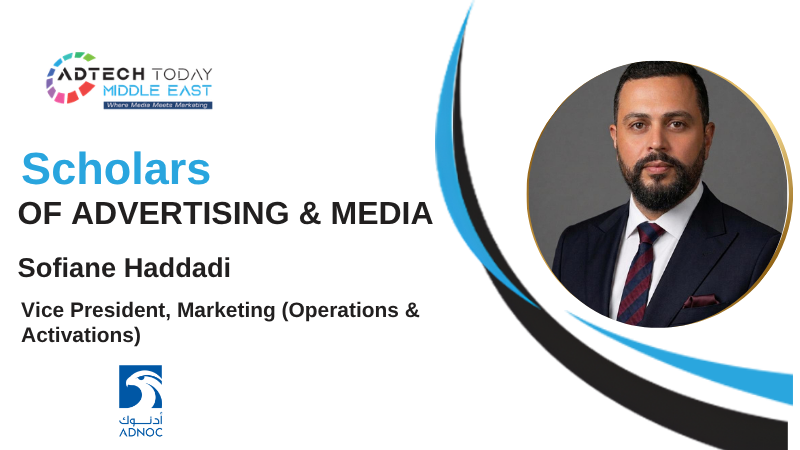
Retail media grew up in the supermarket aisle, where the customer browses. The forecourt is the opposite: a short visit, a fixed errand, and the same faces returning week after week. Sofiane Haddadi is building a media business on that difference, as Vice President, Marketing (Operations & Activations) at ADNOC Distribution, shaped by years on the platform side at ByteDance.
In this exclusive interview, Sofiane explains why one station sells energy drinks and the next sells matcha, makes the case that frontline staff are a brand’s most credible influencers, and argues that AI buyers will reward the same signals people do.
You moved to ADNOC Distribution from the platform side at ByteDance. What does someone who has sat inside a platform notice about brand marketing that brand marketers tend to miss?
What you notice very quickly inside a platform like TikTok is that brands are not only competing with their direct competitors. They are competing with everything else that appears in a customer’s feed.
A fuel retailer is not only competing with another fuel retailer. A coffee brand is not only competing with another coffee brand. In the feed you are up against football, fashion, food, family, entertainment, creators, news, humor: everything that captures attention. Attention is the most valuable currency, and customers do not think in categories the way marketers often do.
Brand marketers spend too much time looking sideways at competitors and too little time looking at customer behaviour. They also over-engineer content. Too many approval rounds, too much internal opinion, and by the time the work goes live the moment has passed.
The brands that perform best on platforms behave differently. They run more tests, learn faster, and let the algorithm and the audience show them what works. It is less about creating one perfect asset and more about building a system that produces relevant content at speed.
The other thing TikTok teaches you is that creators are not just distribution. They need space to bring their own point of view and speak to different communities and passion points. And brands underestimate their own customers. Loyal customers, frontline teams and real users can become some of the most credible voices in the ecosystem if you give them a reason and a platform to do so.
“The biggest shift is realising you are not competing within your category: you are competing for attention against everything in the customer’s world.”
ADNOC Distribution and Landmark Group have built one of the region’s largest loyalty programmes. What does that data make possible that was not before?
Traditionally, a brand might know that someone bought fuel, coffee or a convenience item, and nothing beyond that. When trusted ecosystems connect responsibly, you get a much richer understanding of the customer’s journey.
The partnership with Landmark Group allows two-way point conversion between ADNOC Rewards and Shukran, which links 2.69 million ADNOC Rewards users with 7 million Shukran members in the UAE. Points earned in one place can be spent in the other.
That lets us design more relevant, contextual experiences around real-life moments: the commute, the family shop, the school run, travel, the lunch break, weekend errands. For customers the benefit is simple, more choice, greater value, more useful offers. For brands and partners it opens the door to deeper segmentation, smarter partnerships, more meaningful personalisation and better measurement. You can understand which offers drive actual behaviour, not just impressions or clicks.
It is also transformational for retail media. First-party data lets you build audiences from real behaviour and preferences, and close the loop between media exposure, offer engagement, store visit and transaction. That creates greater accountability, and it means marketing investment can be measured against tangible business outcomes rather than media metrics alone.
A forecourt is a very different environment from a supermarket aisle — shorter dwell time, far higher frequency. What transfers from conventional retail media, and what has to be rethought?
What changes is the customer mission. A supermarket is often a browsing environment. A forecourt is mission-driven. Customers are looking for speed, convenience and immediacy.
That means communication has to be more relevant, more contextual, and often much simpler.
ADNOC Distribution operates around 600 stations across the UAE, serving very different customer segments and occasions. A station in an urban business district behaves differently from one in an industrial area or on a highway. The customer profile, the product mix and the purchase motivation can vary significantly from one location to the next.
That creates an opportunity to localise retail media and offers at a highly granular level. You can optimise everything from product assortment to promotional messaging based on actual customer preferences. An industrial-area location may over-index on energy drinks and grab-and-go meals, while an urban location has stronger demand for premium coffee or trendier drinks: matcha, Spanish lattes, ube.
The more accurately you understand customer journeys at a local level, the more relevant the experience becomes for both customers and advertisers.
“Retail media is most effective when it reflects the context of where customers are, what they need, and what they are most likely to do next.”
Your network hosts brands including McDonald’s, Starbucks and KFC. How does being both landlord and media owner change those conversations?
Being both landlord and media owner fundamentally changes the relationship. Traditionally, the conversation stops at location, traffic and rent. As a media owner with a large loyalty ecosystem and rich first-party data, we can have a much broader conversation about growth.
We can help partners understand customer behaviour and where the adjacent opportunities are. More importantly, we can influence that behaviour by driving the right audiences into those locations, rather than simply leasing space. For brands such as KFC, Hardee’s and Krispy Kreme, we can combine physical presence, loyalty, retail media, CRM and promotional mechanics into one proposition. We recently expanded our collaboration with Americana, opening up customer acquisition, cross-brand engagement and long-term value.
Rather than providing physical space, our retail media network combines first-party data, AI-driven audience insights and advanced targeting to reach the right customers with the most relevant content at the right moment.
“The future of partnerships will not be defined by who owns the location. It will be defined by who understands the customer best, owns the customer relationship, and can create value across every stage of the customer journey.”
You have said brands underestimate that their frontline staff and customers are their real influencers. How do you build that into a media strategy?
Most brands think of influencers as people with large audiences on social platforms. Some of the most influential voices a brand has are its own employees and customers, the people interacting with it every single day.
Frontline teams are the first and most frequent touchpoint a customer has. They understand needs, frustrations and behavioural shifts long before those trends appear in a dashboard, and they are the living embodiment of the brand experience. The first step is to listen to them: frontline insight should shape marketing decisions as much as a research study or an analytics report.
The second step is to empower them. Every campaign and offer should be understood and delivered consistently by the people who meet customers every day. Media should not end when a customer walks into a store; it should continue through the whole journey.
The same applies to customers. User-generated content, reviews and testimonials often carry more credibility than branded advertising, because they come from genuine, lived experience. The strongest strategies bring creators, customers, frontline teams and brand advocates into one ecosystem. People trust others far more than they trust brands. The most effective media strategies do not just amplify marketing messages; they amplify credible voices.
“People trust others far more than they trust brands. The most effective media strategies do not just amplify marketing messages; they amplify credible voices.”
If commerce becomes more agentic, with AI increasingly making the purchase decision, what happens to a retail media network built around human attention?
I don’t believe human attention disappears. I believe the definition of influence expands. Today, retail media is largely designed to influence human decision-making. In an agentic future, AI may play a much larger role in product discovery, recommendation and purchase. That means brands will need to be discoverable not only by people, but also by intelligent systems acting on their behalf.
The winners will be brands with the strongest signals: trusted products, relevant offers, rich first-party data, strong availability, exceptional customer experiences. Those become the signals AI is most likely to recognise, recommend and act upon.
For retail media networks, this creates an opportunity rather than a threat. You move beyond selling impressions and become a provider of customer intelligence and measurable business outcomes. The combination of first-party data, customer understanding and physical presence becomes more valuable, because it enables highly relevant engagement at scale.
Retail media will continue to matter because humans still make emotional decisions. AI makes the ecosystem more personalised, more predictive and more efficient, but the next evolution is not about more screens or more impressions. It is about using data, loyalty, location and AI to create more relevant experiences that deliver measurable value for customers, brands and retailers.
“Brands will need to be discoverable not only by people, but also by intelligent systems acting on their behalf.”

- Embedded Finance Is a Marketing Decision, Not a Banking One - October 7, 2026
- EMIR and Omnicom Media MENA Partner to Amplify GCC Thought Leadership - September 9, 2026
- We Are Now Using AI To Fire Customers For Our Own Bugs - September 8, 2026