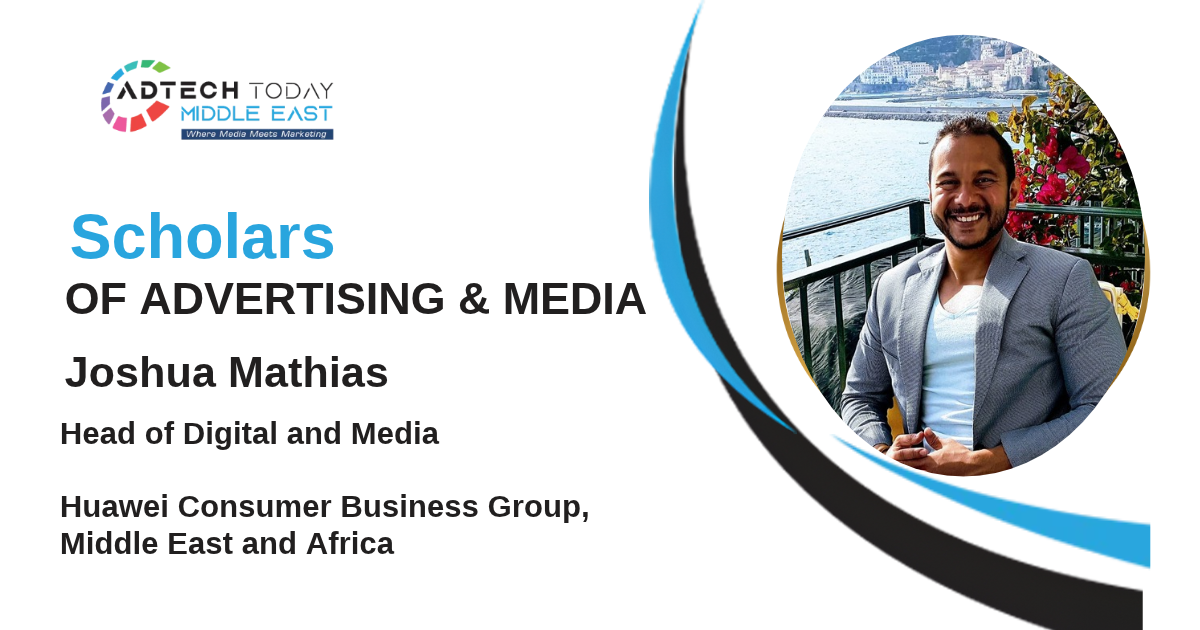
Some of the best results Joshua Mathias has seen came from people nobody expected to buy. As Head of Digital and Media for Huawei Consumer Business Group in the Middle East and Africa, he plans media across more than 20 markets and over 15 product categories. Earlier, he spent more than eight years planning media agency-side.
In this exclusive conversation with Adtech Today, Mathias explains what that taught him about planning a launch, and why marketing to AI assistants will soon matter as much as marketing to people. From a product written into a TV storyline to the next dollar of budget, his test is the same: show what it delivers.
You plan media across more than 20 markets and 15-plus product categories. When two markets compete for the same budget, what usually tips the decision?
Markets don’t necessarily compete for the same budgets, as each has its own revenue targets, which then determine its marketing investment priorities. Regional investment support decisions for each market are driven by commercial potential, strategic importance and opportunities to strengthen brand health.
The real competition is around performance and innovation, not budgets. We encourage markets to outperform on ROI, media KPIs, search demand and brand health while pioneering new media approaches. When one market demonstrates strong returns and sales growth, it creates a benchmark for others to make a stronger business case for additional investment. At a regional level, we support testing in selected markets, measure impact and scale successful practices across the region.
Ultimately, it’s about creating a culture where markets compete not for bigger budgets, but for better results, innovation and the ability to justify greater investment through proven performance.
Precise targeting is often the default. When does broader reach do more for a product launch?
Precise targeting and broader reach play different roles depending on the product and the consumer journey. I’m a strong believer in broader reach, particularly for high-profile product launches, for two reasons.
First, consumers don’t always behave as we predict. In my experience, some of the strongest conversions have come from audiences we least expected to purchase. Precise targeting might miss these high-value audiences. Second, broader reach helps stimulate search demand and build richer data pools, which we can use for more precise retargeting.
For niche products with longer purchase cycles, precision becomes more important to build consideration, without completely sacrificing broader awareness. Similarly, as consumers move down the funnel, targeting should become more focused on high-intent audiences to drive conversions.
“In the end, it isn’t broad versus precise targeting. It’s about striking the right balance based on marketing budgets, product positioning, commercial objectives and the consumer purchase journey.”
Product integration woven into a show can land very differently from a product simply placed on screen. What makes that integration feel like part of the show rather than an interruption?
Product integration is a powerful way to create a pull rather than push effect, showcasing products naturally through content and talent that audiences connect with.
I believe three principles drive success.
- Authenticity over exposure: integrate the product into the storyline. It’s about quality over quantity, and enhancing the viewing experience, not disrupting it.
- Relevance: Ensure the product and its features complement the show’s story line, solve a problem & connect with the audience and narrative.
- Measurable impact: go beyond exposure to assess whether the integration drives social engagement, search demand, stronger brand perception and, ultimately, business outcomes.
What matters isn’t how often the product appears, but how naturally it fits, resonates with audiences and delivers measurable impact.
As brands begin tracking how AI assistants describe them, how should that measure sit alongside ROAS?
GEO (Generative Engine Optimisation) is growing in importance alongside ROAS. While ROAS measures how efficiently we convert demand, GEO helps us understand how effectively we influence it.
“As AI increasingly shapes purchase decisions, marketing to AI assistants will become as important as marketing to consumers.”
Key GEO metrics should include AI visibility, competitive share of voice, citation quality, recommendation rankings and the accuracy of AI-generated responses. Equally important is identifying gaps and optimising content to improve visibility.
GEO should sit alongside ROAS through an incrementality lens. Are improvements in AI visibility driving incremental growth in branded searches, qualified traffic, consideration and sales? We need to validate this through test-and-control markets or before-and-after analysis, accounting for other marketing activities.
The goal is not AI visibility for its own sake. It’s proving its contribution to incremental business growth.
You spent more than eight years planning media agency-side before moving to the brand. What did that experience teach you about getting the best from agencies, something clients often overlook?
Having worked on both sides, I believe the best agency relationships are built on empathy, professionalism, mutual respect and constructive challenge.
“My agency experience helps me understand their pressures and distinguish genuine constraints from excuses.”
I know when to support, when to challenge and when to push teams beyond what they thought possible. Equally, agencies have challenged my thinking, helping us pioneer new media approaches, team structures and measurement solutions that drive business impact.
What clients often overlook is that agencies deliver their best work when they’re treated as business partners, not service providers. Give them ownership, build trust and hold each other accountable.
Empathy and professionalism build trust, and that trust is what allows us to push boundaries and drive exceptional results.
Your measurement runs from brand health through to sales contribution. Looking ahead to 2027, which measurement gap do marketers in the region most need to close?
I believe the biggest measurement gap is connecting data across departments, from media and sales to channel, service and PR/comms, to understand how their collective efforts drive business outcomes.
With growing budget pressures, marketing science, particularly predictive analytics, will be critical in forecasting the optimal budgets, platforms and content strategies to maximise incremental sales and ROI. Forecasting will never be an exact science, but we need to get as close as possible.
Equally important is simplifying complexity for the C-suite, who are constantly exposed to vast amounts of data across different business functions. We need to invest in the right measurement tools, integrated dashboards and AI-driven analytics that connect these data points and reveal relationships, which can then be translated into actionable business decisions.
“The holy grail is moving from reporting what marketing delivered to predicting, as accurately as possible, what the next dollar invested will deliver for the business.”

- Marketing’s Holy Grail Is Predicting What the Next Dollar Will Deliver: Huawei’s Joshua Mathias - November 18, 2026
- Nine months of the UAE Advertiser Permit: What Really Changed For Brands And Creators - November 17, 2026
- Mohamed Mordi: Context Turns Retail Data Into Growth - November 11, 2026