
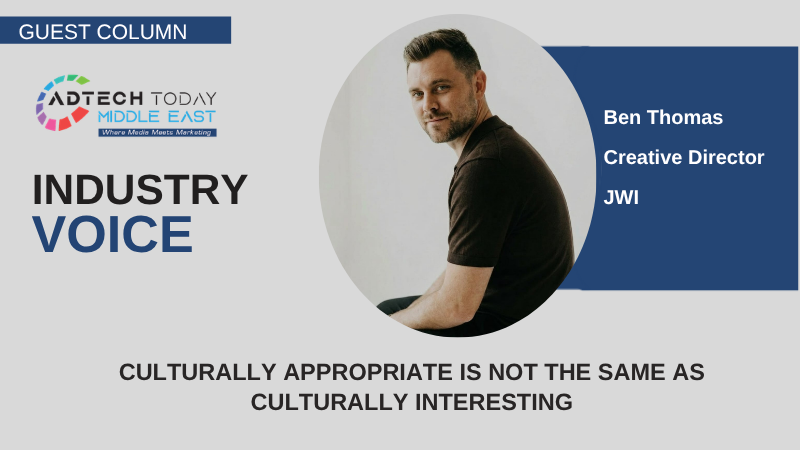
Ben Thomas, Creative Director at JWI, on why “local” in a brief too often means a global campaign with a new cast, language and location. He argues for starting with behaviour rather than demographics, knowing when culture shouldn’t be the point, and asking afterwards what the work achieved for the brand.
After almost ten years working in the region, I’m still wary of the word “local” in a brief. It can mean a real understanding of the audience. It can also mean taking an existing campaign that has run globally, and simply changing the casting, language and location.
Those changes may be necessary, but they won’t resolve an idea that has little relevance to the people it’s meant to reach.
For me, the work starts with understanding what matters to the audience and why the brand has a role in that.
Start With Behaviour
When we develop campaigns for global brands across the region, I come back to three questions: who are we speaking to, what are we trying to change and why should they care?
“The region” is too broad to answer any of those properly. What feels true in Saudi Arabia might feel off in the UAE. Even “Saudi women” or “young people in Dubai” as a target audience is only a starting point. Which people? What matters to them in this particular situation?
On a creative brief, I’m much more interested in the behaviours that connect people, or separate them, than a demographic label we’ve decided explains everything.
The useful details are often small. How someone behaves around family compared with friends. A particular kind of humour. Something people do without thinking about it. One well-observed detail can give an idea more meaning than a frame full of recognisable symbols.
“One well-observed detail can give an idea more meaning than a frame full of recognisable symbols.”
That understanding should make us more ambitious creatively. I want an idea that connects with the audience and stands up to the same scrutiny we’d give any strong work, anywhere. A familiar reference alone won’t carry it.
Not Every Campaign Needs To Be About Identity
We don’t need to turn every product into a statement about someone’s identity.
Sometimes we’re selling a razor, or a skin care product. In these cases, understanding someone’s routine, frustrations and expectations might be far more useful than making a big statement about who they are. Cultural understanding should serve the marketing objective, rather than becoming the objective itself.
“Cultural understanding should serve the marketing objective, rather than becoming the objective itself.”
People should be able to see themselves in the work without the work constantly announcing that it represents them. Cultural understanding helps us find the right way in. It still needs to make the product matter to them.
Give Expertise Real Influence
No team understands every audience equally well. Part of my responsibility is recognising where we need another perspective and bringing it in early enough to matter.
At JWI, we bring in talent and consultants with knowledge of the particular market and audience, then involve them throughout the work. I want those people to have enough influence to question the brief and challenge the direction.
Being culturally appropriate and being culturally interesting are different things. You can avoid every mistake and still produce work that says very little—checking that something is acceptable matters. So does finding something people will recognise, enjoy or respond to.
“You can avoid every mistake and still produce work that says very little.”
That takes trust within the team and with the client. Senior involvement matters when it brings clear judgement and accountability. Continuity matters because each brief should build on what we’ve already learnt about the client’s business and audience. The relationship gets stronger when we can have an honest conversation about an idea and take responsibility for where it goes.
Know When To Hold Back
The brand needs to retain its own character throughout this process. The strongest work finds a connection between what the brand stands for and something relevant in people’s lives.
Sometimes that calls for restraint. A brand doesn’t need to comment on every occasion or claim a place in every conversation. If the connection feels forced, I’d question why we’re making it.
Consistency and long-term understanding matter far more than a single campaign decorated with familiar cultural cues. Understanding develops through paying attention, listening and carrying what we learn into the next piece of work.
Ask What The Work Achieved
After a campaign, I still want to know what that cultural understanding did for the brand.
Has it made the product’s role clearer? Made the message more convincing? Given someone a reason to reconsider or try it?
Those questions should be part of the brief from the beginning and part of the debrief afterwards. A reference people recognise might get a reaction. I want to understand whether that reaction helped us achieve what we set out to do.
For me, getting culture right means bringing all of this together: understanding people well enough to make strong creative decisions, building relationships where expertise is trusted and keeping sight of what the business needs the work to achieve
Disclaimer: This article was originally written by the author. Views expressed are the author’s own. All rights belong to the original author.