
Most companies do not fail in the Middle East because they lack capital, capability, or intent. They fail because they misunderstand the role communications plays for them.
“They think they are entering a market, but in reality, they are entering a system of scrutiny.”
I have watched companies arrive with detailed expansion plans and complete confidence in how those plans will land. However, communication gets left until the end. The messaging is adjusted, a launch is lined up, and media is briefed. And within weeks (or sometimes even days), the gap begins to show. This is not because the strategy is wrong, but because the company has revealed, through its communication, that it does not yet understand the environment it has entered.
The Middle East is not a single communications environment
The first mistake is to collapse the region into a single narrative. It is still common to see companies approach the UAE, Saudi Arabia, and the wider Gulf with a single communications plan. One story, one tone, one rollout. And while it looks efficient and reads well in a global deck, it does not translate to what is happening on the ground in the market.
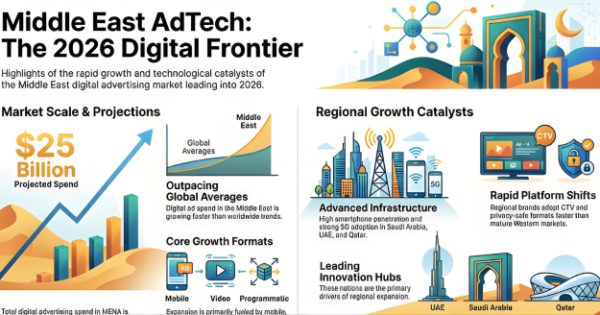
The region is expanding quickly, but not uniformly. According to IAB MENA’s 2024 digital ad spend update, digital advertising reached $6.95 billion in 2024, up 19.8% year-on-year, with Saudi Arabia growing even faster at 23.5%. Meanwhile, Strategy&’s MENA Media and Entertainment Outlook, 2024–2028 projects the regional media and entertainment market to grow from $15 billion in 2024 to $18 billion by 2028, with Saudi Arabia and the UAE remaining the dominant markets. Growth is clearly not the problem. Assumption is. Each market carries different expectations around messaging, credibility, and visibility. When companies flatten those differences, they do not simplify communications but end up diluting it.
Translation is where most strategies start to slip
The second mistake is more subtle. It is the belief that localization is primarily a language exercise. It is not. Translation adjusts words.
“Localization adjusts meaning, tone, and intent.”
A message that comes across as confident in New York can be completely misconstrued in Dubai.
The Reuters Institute’s Digital News Report 2025 shows continued movement toward platform-driven news consumption globally. Regionally, Strategy&’s analysis of the MENA news industry found that 68% of respondents across the region’s three key markets said social media was their primary source for news. In comparison, more than 90% cited mobile as their top device for accessing it.
That shortens the gap between what you say and how it lands. There is not much room to recover if the tone misses. People pick up on it quickly. This is rarely about the words. Instead, it is about what those words reveal about the companies’ assumptions.
Communications is not a launch function
Another persistent miscalculation is timing. Many organizations treat communications as something that starts when they launch through an announcement, a campaign, and a wave of visibility. The assumption is that awareness leads to traction. But in this region, it often works the other way around.
Communications functions as a trust system. It sits across media, stakeholders, regulators, and commercial partners.
“Visibility without credibility does not build momentum.”
If anything, it can result in hesitation. The more effective organizations establish a presence before amplification and focus on legitimacy before looking for coverage. They recognize that the question is not just what they are saying, but why the market should accept it.
Your positioning is not something that is announced. It is something the market decides, often before you realize that judgment has been made. In a region where media and market dynamics evolve quickly, weak positioning gets exposed faster than many global teams expect.
Regulation is not separate from communications
The final mistake is treating regulation as a compliance tick box and not as a communications variable. In the Middle East, the two are increasingly connected.
For example, in the UAE, individuals engaging in advertising activities on social media platforms must hold an advertiser permit, whether that activity is paid or unpaid. The official Advertiser Guide ties that requirement to Decision No. (3) of 2025 and the UAE’s broader media law framework. A campaign that does not align with regulatory expectations may signal that the company does not fully understand how the market operates.
The same applies to broader stakeholder alignment. In many cases, communications needs to sit within national priorities, sector strategies, and long-term economic positioning. That requires intent, not adjustment. You cannot retrofit seriousness into a message once the market has already decided you arrived with a template instead of a point of view.
Where companies get it right
The organizations that navigate this successfully do not treat communications as a downstream function but as part of market entry itself.
The companies that get this right tend to work differently from the start. They build their messaging inside each market. This means the tone shifts from the global stance. Sometimes it is subtle, and other times it is more than expected. Communication is where a company first shows whether it understands the market, or is still trying to adapt to it.
Strategy can stay internal for quite a while but communication cannot. It is out there immediately, being read, interpreted, and tested in real time. Visibility on its own does not build momentum. If anything, it puts pressure on the business to prove it belongs. Companies that get this right also recognise the role of having the right communications partners on the ground. This is not just about execution, but about interpretation. In a market where perception forms quickly, local expertise helps shape how a business is understood from the outset, across media, stakeholders, and regulatory environments.
About the Author
Hilmarie Hutchison, CEO, Matrix Public Relations. She is a Chartered Public Relations Practitioner, the recently named “PR Leader of the Year,” and CEO of Matrix Public Relations, an award-winning boutique agency in Dubai. With over two decades of global PR experience, she drives business strategy and counsels clients across multiple industries. A recognized regional leader, Hilmarie serves on the MEPRA Strategy Board, is a four-time PRWeek Middle East Power Book honoree, and authors thought leadership for numerous industry publications.
Disclaimer: This article was originally written by the author. It is shared here for educational purposes. All rights belong to the original author.