

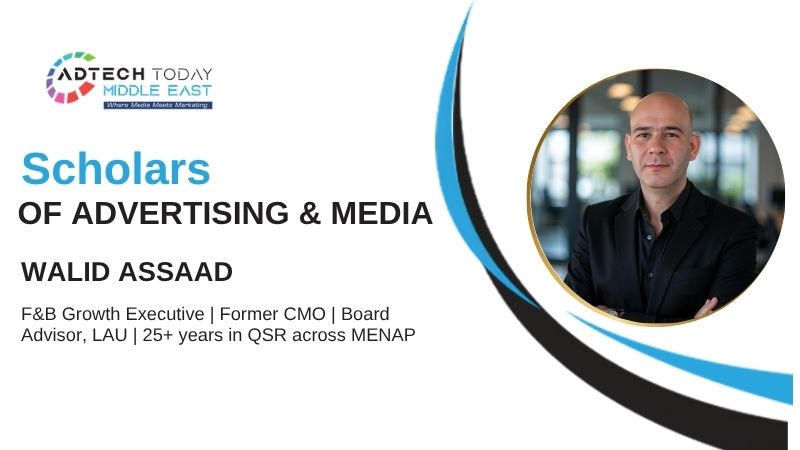
Walid Assaad has spent 25 years building brands including McDonald’s, Subway across 13 MENAP countries, Nestlé and NKD Pizza, across the Middle East and beyond. His career has taken him from physical retail, where a brand is built over years and measured in footfall, into the cloud-kitchen model, where a single operator can run sixteen delivery-only brands and a marketing budget is judged in weeks.
In this candid and unusually practical conversation, he tells Adtech Today Middle East what physical retail taught him that virtual brands made him unlearn, why he now treats marketing as a weekly capital-allocation decision, and what a Western marketer tends to get wrong about the young Saudi consumer.
You built McDonald’s and Subway, businesses defined by physical presence, to brands with no storefront at all. What did you have to unlearn?
The deepest unlearning wasn’t tactical; it was structural: how I built and measured a marketing organisation. At McDonald’s and Subway, budgets were weighted toward brand-building with a long payback horizon, and success was measured in footfall, share of category, and multi-year equity tracking. In a virtual-brand model, I had to rebuild the P&L logic entirely. Marketing spend now has to justify itself in weeks through CAC, repeat-order economics, and platform-ranking lift, or it gets reallocated to a brand proving itself faster.
That changed how I structure both the team and the budget. Less investment in long-cycle brand campaigns, more in a continuous testing engine with real-time reallocation across sixteen P&Ls. I had to stop treating marketing as a single annual plan and start treating it as a live capital-allocation function, where the real skill isn’t crafting the perfect campaign; it’s deciding, weekly, which brands earn the next dollar based on evidence, not conviction.
“The physical world lets you be patient. This one demands you be decisive, constantly, and with incomplete information.”
With sixteen brands running at once, you’re effectively watching sixteen live experiments. What has that taught you that a single brand never could?
Running one brand teaches you depth. Running sixteen teaches you which parts of “brand building” were actually just repeatable operating discipline wearing a costume. When you strip away the logo and the story, you can see with brutal clarity which levers move orders: packaging that survives a scooter ride, a menu photographed a certain way, a price point that clears a specific delivery-fee threshold. You’re running the same experiment sixteen times with different creative wrapped around it.
It also taught me portfolio thinking in a way a single brand never forces on you. Some brands are cash generators, some are customer-acquisition loss leaders that feed data into better-performing siblings, some exist purely to defend shelf space in a category before a competitor claims it. You stop asking “is this brand winning” in isolation and start asking what job each brand is doing for the group. That’s a fundamentally different, and healthier, way to think about a marketing budget than brand-by-brand P&L thinking allows.
The delivery platform owns the customer relationship and the data. What can you actually measure, and where are you blind?
I can measure everything downstream of the click and almost nothing upstream of it. Conversion rate, basket size, repeat-order frequency, review sentiment: richer than most physical restaurants ever capture. Where I’m blind is discovery: why the customer opened the app today, and who they are once they leave the platform. That data belongs to the platform, permanently, by design.
That’s the deeper risk: my growth sits on land I don’t own. So I’m building a parallel first-party layer, direct ordering, proprietary CRM, loyalty the platforms can’t see. But it has to be done diplomatically, not adversarially. I don’t ask customers to abandon the platform; I earn the right to a direct relationship after the platform has already introduced us. A follow-up offer post-delivery, a loyalty perk redeemable either way, never a discount that undercuts the platform’s economics or reroutes volume they can penalise in ranking.
The platforms aren’t villains; they’re partners I still need for reach. The skill isn’t escaping rented land; it’s quietly building equity on it without ever looking like you’re competing with your landlord for the tenant.
“The platforms aren’t villains, they’re partners I still need for reach.”
How much of your marketing targets the algorithm versus the customer?
Honestly, more than I’d like to admit, probably close to half at the tactical level. Photo composition, title keywords, menu-item sequencing, promotional timing: these are written as much for the platform’s ranking logic as for a human being deciding what to eat. If you ignore the algorithm, you simply don’t get shown, and a brilliant brand nobody sees is not a brilliant brand.
But I’ve learned to treat the algorithm as a distribution problem, not a strategy.
“It decides who sees you; it doesn’t decide who orders again.”
The moment the food arrives, every bit of algorithmic optimisation becomes irrelevant, and it’s pure product truth: taste, temperature, consistency, value. So I split the effort deliberately: enough algorithmic literacy to earn visibility, and the majority of real strategic energy on the parts the algorithm can’t fake, repeat rate, review quality and word of mouth. Brands that only optimise for the platform win short bursts of orders and lose the business long-term.
A virtual brand can be launched in weeks. Does that turn brand building into something closer to product testing?
At the tactical level, yes, but the more important shift is what it does to capital allocation. When a brand can launch in weeks, testing stops being a pre-launch phase and becomes an ongoing portfolio discipline. My real job isn’t running the test; it’s governing what happens after: which brands get promoted from experiment to funded growth bet, which get sunset before they drain a stronger sibling, and how fast that decision gets made. That’s a growth-officer function as much as a marketing one.
The risk in this model isn’t launching too fast; it’s governance lag: letting a mediocre performer linger because no one owns the kill decision, or under-investing in a genuine winner because it hasn’t been reclassified from test to priority. I built a simple stage-gate: every brand is either in test, scale or wind-down, reviewed monthly against hard thresholds, not gut feel. That discipline is what separates a portfolio that compounds from one that just accumulates. Speed to launch is a commodity now; speed and rigour of the scale-or-kill decision is the actual competitive advantage.
What does the Saudi delivery consumer respond to that a marketer arriving from a Western market would not expect?
The starting point has to be demographics. Over 70% of the Saudi population is under 35, with a median age around 24. That isn’t a footnote; it’s the entire market. A Western marketer often still designs for a mixed-generation audience, when here you’re building for one dominant cohort’s instincts, humour and platform behaviour. Missing that shapes everything downstream, from creative tone to which channels even matter.
Within that, group and occasion-based ordering stands out. A large share of orders are family- or gathering-sized even on an app built for individual transactions, which changes acquisition economics: higher average order value should justify higher acquisition spend than single-serve models assume.
Trust signals also carry more commercial weight than in most Western markets. Certifications, transparent sourcing and community-based social proof measurably move conversion, not just perception. And demand shifts hard around prayer times, Ramadan and weekend rhythms.
“Build acquisition and content around a young, mobile-first majority and these cultural rhythms, and cultural fluency becomes a real growth lever, not just a courtesy.”

- EMIR and Omnicom Media MENA Partner to Amplify GCC Thought Leadership - September 9, 2026
- We Are Now Using AI To Fire Customers For Our Own Bugs - September 8, 2026
- Initiative Appoints Darine Elkaissi as Managing Director in Saudi Arabia - September 2, 2026