
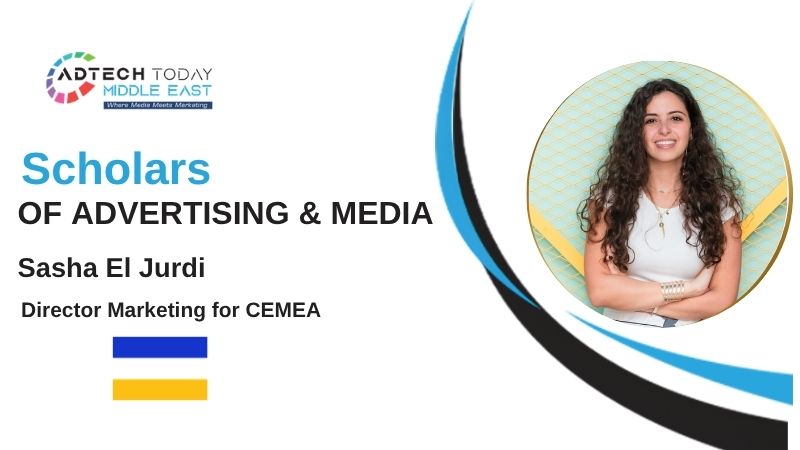
Data-led and refreshingly direct, Sasha El Jurdi has built her career on a simple conviction: attention is earned, and content is what earns it. As Director Marketing for CEMEA at Visa, she leads brand content across Central Europe, the Middle East and Africa, shaped by years spent watching what audiences genuinely choose to watch, save and share.
In this exclusive interview , Sasha shares how data reshaped her instincts, makes the case for giving content the same weight as media, and explains why storytelling will outlast every shift in technology.
You’ve made content from the agency, the platform and the brand side. Most people romanticise one of those seats. Which one taught you something the other two never could, and what was it?
Every seat taught me something the other two couldn’t. At the agency, FP7/McCann, I learned craft: how to turn a client brief into an idea that could travel across formats, back when content served a media mix that still revolved around OOH, BTL and print.
TikTok, which I joined in 2020 right as the world went into lockdown, taught me behaviour. I was at the platform during the biggest content boom in a decade, watching in real time what people chose to watch, save, recreate and ignore. That is where I got close to data. I used to be intimidated by numbers. Now I am obsessed with them, because they reveal what audiences actually value rather than what a brand assumes they value.
Visa taught me strategy. Here, content cannot just be engaging. It has to tie back to business priorities and growth targets, and owning that link makes the role feel genuinely entrepreneurial.
Together, those three seats build a perspective you cannot get by staying in one of them. It is a path I would recommend to anyone serious about a career in content.
Inside a platform, you saw how content is actually rewarded. Now you’re on the brand side competing for that same attention. What do brand marketers get wrong because they’ve never seen it from the inside?
The biggest misconception is that attention can be bought.
“Distribution does not create interest; it only amplifies it.”
If the content is not resonating, no media budget can fix that. That is exactly why I would flip the usual investment split. Most brands treat paid media as the serious strategic spend and content as a production cost, when both budgets should hold equal weight. Media buys reach for a single campaign. Strong content that brings out a brand’s personality builds affinity that grows over time, and the right content strategy can go viral in a way a paid push simply cannot buy.
Then there is the question of what counts as good content. Too often it comes down to personal taste: what a marketer likes, what got approved, or what feels on brand. None of that is how platforms actually reward content. What defines good content should only be data: a proper measurement system that analyses what people watch, save, share and choose to recreate themselves. Brands that build strategy from that evidence, instead of from opinion, are the ones that consistently win.
You’ve said the businesses that win won’t be the loudest. When budgets come under pressure, how do you defend earning attention instead of simply buying it?
I ask myself one question: would anyone engage with this if it were not being promoted?
If the honest answer is no, the problem was never the media budget. It was the content. Spending more to promote it does not fix that. It just makes the mistake more expensive.
Unlike creators, brands start at a trust deficit. Nobody opens a platform hoping to see an ad.
“So earning attention means either showing up inside culture in a way that feels native to the platform, not just present on it, or building a point of view distinctive enough, through humour, emotion or a genuine perspective, that people choose to engage rather than scroll past.”
That only happens when you understand your audience well enough to know what
will actually land. That is the case I make when budgets are questioned. Media can buy visibility for as long as the spend lasts. Only content earns the kind of attention that builds loyalty, and loyalty is what protects a business once budgets get cut
Unlike fashion, food or entertainment, payments are largely invisible until something goes wrong. What does that force you to do differently to create relevance and emotional connection across the region?
Payments are one of the most important parts of the commerce experience, and they are becoming more invisible. The magic is in how quietly they sit inside every other category, so the experience never breaks.
Fashion is buying the outfit you love. Food is paying for dinner with friends. Travel is booking the flight and the hotel. Payments are the enabler behind all of it. Without them, those moments don’t happen. So our job isn’t to make people care about payments in isolation. It is to show how Visa helps unlock the things they already care about.
What it does force us to do differently is resist making the payment the hero of the story.
“Nobody dreams about a transaction. They dream about the milestone it made possible.”
So the work is finding real, credible intersections between Visa and the passions people already have across the region, whether that’s sport, travel, music or entrepreneurship, and telling stories about progress rather than about product.
The emotional connection isn’t built by explaining how payments work. It’s built by showing up inside the moments people already care about and making the path to them easier and more rewarding. That’s a harder brief than most categories get, because there’s no obvious hero product to film. But when we get it right, the brand earns a kind of relevance a flashier category often cannot.
You’ve recently stepped into the regional marketing leadership role. What’s one belief about content or marketing in the region that you think deserves to be challenged?
What deserves to be challenged is the definition of ‘social-first’.
Most brands treat it as being present across channels. I think it means building a strategy that resonates on each platform on its own terms, and being willing to test,
fail and try again instead of only playing safe bets. It means studying the brands that have genuinely done this well and connecting that back to your own category and positioning, so people associate something with the brand itself, not just a single campaign.
Actually being social-first requires two things. Content budgets have to stop being a fraction of the media budget and be considered in their own right, because content is the foundation for long-term brand love. And success has to be judged properly: at a campaign level against business objectives, but also weekly, monthly and annually, to see whether content and campaigns are compounding into real affinity over time.
That is where engagement matters more than reach or views, and where engagement itself needs to be split into high and low value. That split looks different on every platform, because each one prioritises different signals and people engage for different reasons.
As AI increasingly sits between brands and consumers, some argue marketers will start creating content for algorithms rather than people. Do you agree, or does storytelling become even more important?
Storytelling will always win. These platforms are built on it: people are hooked to short stories from creators they love, celebrities they admire, and people they know. That does not change because AI enters the mix. What AI changes is who gets to tell stories well. It removes the production limits for brands and creators who previously could not compete on polish, and that can be a good thing.
Right now we are still asking whether something was made with AI, comparing one AI-generated experience against another. That question will fade. Soon we will simply ask whether the content was worth our time, the same way we always have. We saw this exact pattern before, when short-form, lower-production content started replacing polished long-form work. Vine asked the question first and it did not stick. A few years later the same shift landed and held, not because the format changed, but because the storytelling behind it finally caught up.
So no, I do not think marketers will end up creating purely for algorithms.
“The algorithm can only amplify a story. It cannot write one people actually care about.”

- EMIR and Omnicom Media MENA Partner to Amplify GCC Thought Leadership - September 9, 2026
- We Are Now Using AI To Fire Customers For Our Own Bugs - September 8, 2026
- Initiative Appoints Darine Elkaissi as Managing Director in Saudi Arabia - September 2, 2026