
It hasn’t been long since personalisation was regarded as a differentiator. Now it’s the bare minimum if you want to keep your consumers engaged and by your side. And as AI makes it easier for anyone to offer a personalised UX, the battlefield shifts to something algorithms can’t replicate: emotional connection and the feeling that the brand hears the human behind the screen. In 2026, the whole point for brands is redefining what makes them irreplaceable when the technology itself already works flawlessly.
“As AI makes it easier for anyone to offer a personalised UX, the battlefield shifts to something algorithms can’t replicate: emotional connection.”
The Brand Priorities Shift
The UAE is a global leader in adoption. The 2025 Edelman Trust Barometer, cited in Microsoft’s AI Economy Institute report, places AI trust in the UAE at around 67%, against just 32% in the United States. Yet when retail giants and SMEs have almost the same enterprise-level AI stack, saying “we have AI” no longer means you have a competitive advantage.
This ease of access has led companies to integrate AI-driven decisions without a clear long-term strategy, let alone deeper analysis. Gartner projects that over 40% of agentic AI projects will be cancelled by the end of 2027, citing escalating costs, unclear business value and inadequate risk controls. The lesson is not that businesses should move more slowly, but that AI must serve a defined purpose: improving efficiency and customer outcomes, rather than merely helping a brand keep pace.
The Trust Difference
That judgement matters most when AI shapes the customer experience. Too often, adding tech is driven by a desire to look innovative rather than by the need to solve a real friction point. A Visa and Fast Company Middle East study identified a disconnect: only around a third of regional companies make technology decisions with customer value in mind. The result is a gap in the emotional layer of the customer journey, and with it, a deficit of trust.
Successful brands here need to know exactly what can be automated and what has to stay under human review. They also understand that emotion beats discounts: over half of marketers agree an emotional message resonates more, according to Bloomreach and EMARKETER.
This matters most in the premium sector, where the relationship carries as much weight as the product. Anne Azais de Vergeron, CEO of Repossi, has noted that modern luxury consumers are buying less frequently but with far greater intention, looking for pieces that carry meaning and reflect their identity. As journeys become more automated, consumers need a stronger emotional reason to choose one brand and stay with it.
The Key to Balancing AI Fatigue
AI is great at powering product discovery and easing decision-making, but the point is to keep it a calm and useful supporter, not an annoying assistant.
Around 85% of UAE consumers use AI tools to assist their shopping. Only a third trust an AI agent to complete checkout independently. The design principle is clear: AI can take over the effort around a decision, but the decision itself should remain with the customer.
A recent collaboration between Visa and Aldar shows how to manage that boundary. Their voice-enabled agentic payment system, the region’s first, handles the entire routine, finding the bill, filling in the fields, setting up the transaction, and still leaves the final payment decision to the human.
Where Human Value Sits
The more powerful AI becomes, the more obvious human value becomes. Machines excel at routine operations, but leave behind what is hardest to code: empathy, navigating uncertainty, and the ability to read nuanced context.
A Gartner survey found 64% of consumers prefer companies keep AI out of customer support. When something goes wrong, the fear isn’t whether a bot can help, but whether the user will be left without a real person to talk to. People need people.
In 2024, Klarna launched an AI assistant that did the work of 700 employees. By 2025, service quality had dipped, and the company was rehiring support managers. Efficiency is great, but the brand’s soul is greater.
“Efficiency is great, but the brand’s soul is greater.”
The most premium feature of 2026 is an authentic connection built on top of your technology, not instead of it. KPMG’s long-term study of customer experience pillars found that while technical measures such as time, effort and basic personalisation have ticked upwards, empathy remains the slowest-growing metric globally. When automated frameworks are pushed onto too many touchpoints to cut costs, interactions become purely transactional, and customers feel everything has become too generic.
Even global giants stumble here. In 2024, Coca-Cola faced online backlash over a festive ad created with AI. Intended as an homage to its “Holidays Are Coming” commercial, it reproduced the visual assets faithfully, but audiences called it a soulless attempt to recreate family festive values.
For brands across the UAE, the debate is no longer about whether to adopt AI, but where to draw the boundary line. Advanced tech will take care of speed, logistics and data, but only an emotional connection can secure true consumer loyalty and trust.
“The most premium feature of 2026 is an authentic connection built on top of your technology, not instead of it.”
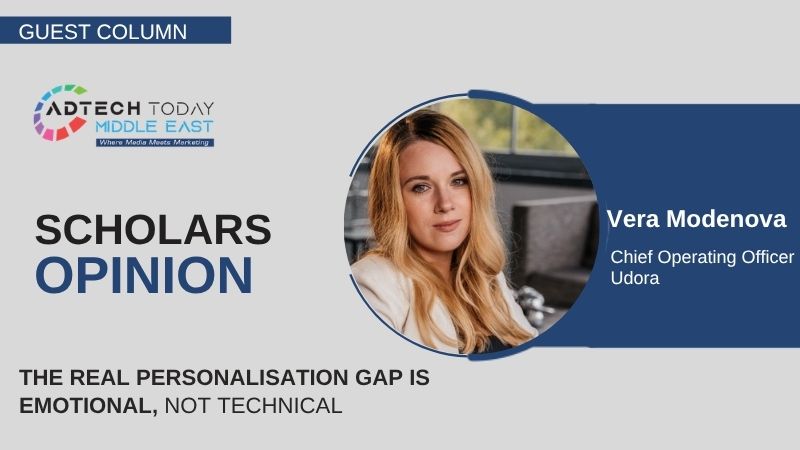
Vera Modenova is Chief Operating Officer at Udora, a gifting platform connecting customers with local florists, confectioners and artisan makers across more than 50 countries and 1,500 cities, including markets in MENA, the UK, Spain and Latin America. She joined the company at 21 and became COO within four years. Over a decade in operations, she built the customer support function from scratch to a 92% satisfaction rate, scaled the platform across Europe and the Middle East, and in 2025 led the business to 129% GMV growth.
Disclaimer: This article was originally written by the author. Views expressed are the author’s own. All rights belong to the original author.

- EMIR and Omnicom Media MENA Partner to Amplify GCC Thought Leadership - September 9, 2026
- We Are Now Using AI To Fire Customers For Our Own Bugs - September 8, 2026
- Initiative Appoints Darine Elkaissi as Managing Director in Saudi Arabia - September 2, 2026