
The region’s programmatic infrastructure has matured fast. Investment behaviour hasn’t kept pace, and too much digital spend still concentrates on a handful of familiar platforms. Following a panel at IAB MENA’s Growth Series, Trevor Dsouza, Investment Director at Radix Media MENA makes the case that comfort has quietly become a substitute for strategy.
Back in May, IAB MENA’s Growth Series brought together a panel billed as a conversation about supply path optimisation. What it turned into was a conversation about something more fundamental: whether the region’s advertisers believe in the infrastructure they’re buying.
Moderated by Ryan Luiz and convened by Ian Manning and the IAB MENA team, the panel put me alongside Saadeddine Nahas, Head of Product and Partnerships at Dentsu; Swati Shukla, Head of Brand Marketing at Kids First Group; and Patricia Lyn Dixon, Global Head of Programmatic at Capital.com. Between the four of us, we covered most of the supply chain: agency, brand and buy-side infrastructure in the same room. It’s a familiar shape for anyone who spends their day in adtech. What was less familiar was how directly everyone was willing to have the conversation.
SPO was never the hard part
The panel’s opening consensus took about ninety seconds to reach. SPO, done properly, is about reducing inefficiency and shortening the path between advertiser and consumer, maximising outcomes, not minimising cost, as Saadeddine put it. Patricia, who has sat on both sides of the table, made the sharper point: a good supply path is a good supply path regardless of where you sit. Quality, transparency, clean links in the chain. That definition doesn’t move depending on your job title.
None of that is controversial anymore. SSP partnerships in this region are mature. Curation tools are advancing fast. Agencies are building their own marketplace infrastructure. SPO has migrated from conference buzzword to a standard line in regional RFPs in about two years, which is fast, even for adtech.
One channel is not a strategy
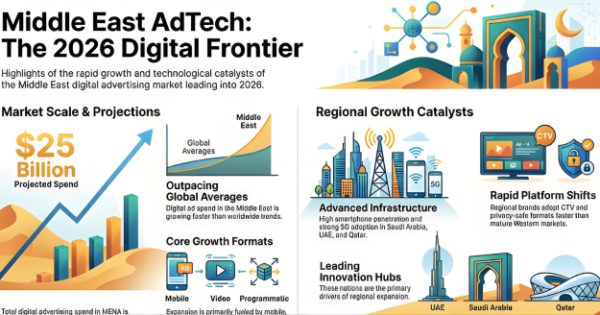
Here’s where the panel got uncomfortable, and where I think the real story sits. MENA is one of the most connected markets in the world by most of the metrics that matter, internet penetration near-universal across the Gulf, mobile identities that outnumber the population. Reach was solved years ago. What hasn’t been solved is where that reach goes.
A significant share of regional digital budget still concentrates on a small number of dominant platforms, not because better options don’t exist, but because those platforms are familiar, their metrics are legible, and they’re easy to defend in a boardroom. I said on a podcast earlier this
month that you cannot do one channel, one format, and call it a media strategy. The panel arrived at the same place from a different direction: comfort is not a media strategy. It’s the absence of one.
“Comfort is not a media strategy. It’s the absence of one.”
That matters more here than in most regions, because MENA isn’t one market, it’s a set of distinct audience cohorts by nationality, language and cultural reference point. Local publishers carry that nuance. Broad, algorithmically served inventory on a handful of walled platforms structurally cannot. If your investment doesn’t reach beyond the comfortable platforms, you’re not under-reaching, you’re overpaying for the wrong kind of attention. This region is still underpriced relative to the quality of attention available in it, but only for traders working the full stack, not just the visible corner of it.
Trust must be built before it’s delegated
Swati said something on the panel that I keep coming back to: brands often don’t have full visibility into how many intermediaries sit between their budget and a final impression, and that’s uncomfortable to admit. That’s not a criticism of agencies. It’s a description of a system that has grown more complex faster than the trust infrastructure around it.
Patricia’s answer was the most useful sentence of the session: trust must be built before it can be delegated. You need to understand what’s happening behind the scenes before you hand over the keys. Ask a hundred whys if you must. That discipline, full-funnel visibility, measured consistently across every channel rather than platform-reported in isolation, is the actual unlock. Not a new tool. A willingness to ask the question until the answer holds up.
“Trust must be built before it can be delegated.”
Two disciplines, one strategy
I would apply the same structural logic here that I use whenever brand and performance budgets get pitched as candidates for merging: don’t. Concentrated platform spend gives you the fast, easily attributed story that’s simple to defend upward. Open programmatic and local publisher partnerships give you differentiation and trust that compounds over a longer curve and doesn’t show up cleanly on a weekly dashboard. Collapse the two into “whatever performs this week” and the legible channel wins by default every time, whether or not it’s the better buy. Run them as two disciplined tracks, planned together and judged by different standards, and the second stops losing arguments it should be winning.
A decade and more into building this business, my view on that hasn’t shifted: stay curious, keep evolving, and follow where the attention is headed, not where the dashboard makes it easiest to look.
Trevor Dsouza is an Investment Director at Radix Media MENA, an independent agency, with 25 years in media across investment and partnerships in the region- still curious, still evolving, always following attention.
Disclaimer: This article was originally written by the author. Views expressed are the author’s own. All rights belong to the original author.

- EMIR and Omnicom Media MENA Partner to Amplify GCC Thought Leadership - September 9, 2026
- We Are Now Using AI To Fire Customers For Our Own Bugs - September 8, 2026
- Initiative Appoints Darine Elkaissi as Managing Director in Saudi Arabia - September 2, 2026