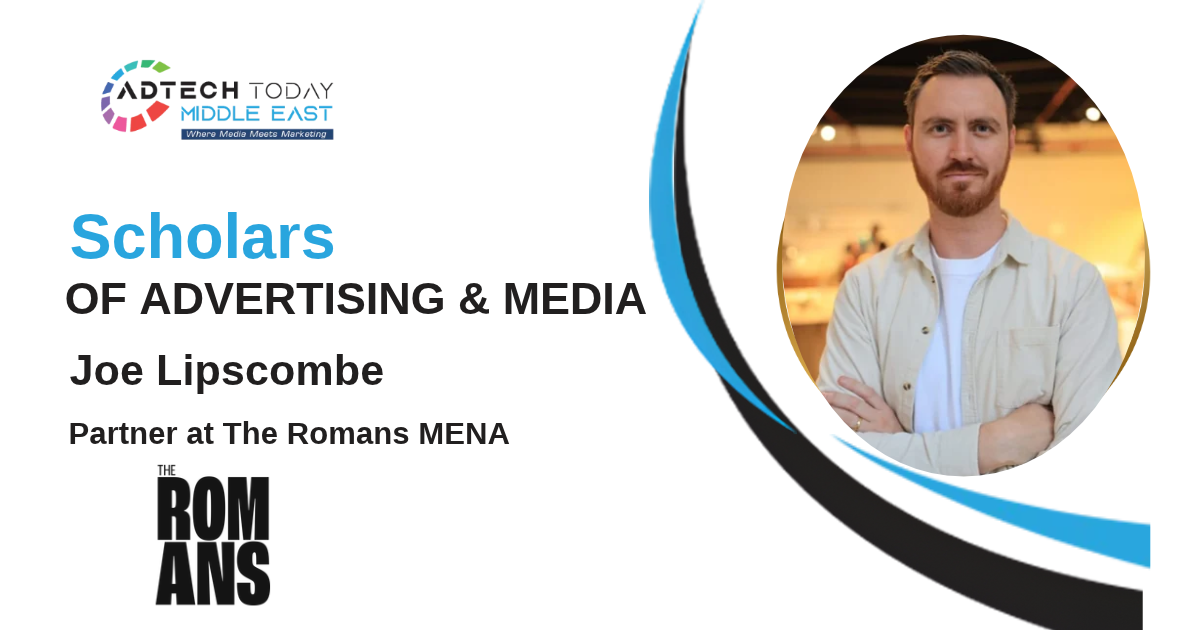
Fans don’t owe brands their attention. A logo beside the pitch may buy visibility, but it won’t earn a place in fan culture. That’s the distinction Joe Lipscombe wants brands to understand. As Partner at The Romans MENA, regional arm of the UK agency named Cannes PR Agency of the Year 2025, he grew the Dubai team from one person to 24 in its first year. Earlier, he reported across the region for Forbes and Bloomberg Businessweek, then spent almost a decade at Ogilvy.
In this exclusive conversation, Lipscombe explains what a sports budget should buy instead, and why he worries AI could leave young communicators directing work they have never learned to do.
You built the Dubai team from one person to 24 in its first year, then brought in a Managing Director to run it day to day. What did you have to let go of personally for that growth to hold?
When you’re leading a rapidly scaling business, every day is a lesson in letting go, adapting and finding new ways to create value and drive the agency forward. For us, it hasn’t been about bringing in new leadership to run things day to day; it’s been about complementary skills. We’re building a full leadership team that can collaborate without ego, support one another, look inward to support our people and clients, and look outward to create and deliver what’s next.
Every founder or partner who has started from zero will know that one of the critical skills is being able to relinquish control of certain areas as and when better people arrive.
You’ve said the region’s fans are bored of logo wallpaper. If a brand stops paying for visibility, what should its sports budget buy instead?
“What makes sport so special is that it is essentially gatekept by the people.”
Fandom drives its success. Anyone paying for wall space is missing an opportunity and wasting hard-earned budget. Instead, a sports budget should pay for the strategic insight and creative edge needed to infiltrate fan culture and earn a place in the spaces fans occupy that media money cannot buy.
Not many PR agencies dare to enter those spaces. The Romans recently brought its Sports & Entertainment business to MENA, led by sports marketing expert Sam Buckett. As Sam puts it, “Too often fans are taken for granted and seen as a captive audience.”
You started out as a reporter in this region. As more people get their answers from AI tools instead of articles, how does a brand earn credibility when the reader may never see the original story?
I have a sense that people will once again lean on a small handful of trusted sources for information. The younger generation is wise to the foibles of the algorithm, and I’m convinced people will go to the horse’s mouth when in doubt. That said,
“Credibility is earned in consistent behaviours that reinforce a brand’s message.”
You certainly need a surround-sound strategy today: one that can influence LLMs while also being visible in the physical world, through the mouths of influential parties, and on owned channels.
I think media outlets are probably having a harder time maintaining credibility in the age of AI summaries. PR professionals have a duty to support them in creating a media environment that’s factual, trustworthy, and rich in substance and quality.
Behavioural science gives communicators real influence over what people do. How do you distinguish helpful nudges from manipulation?
I’ve long been an advocate of integrating more behavioural science into communications. When it comes to certain topics, we should be moving beyond the era of awareness and into the era of action. Behavioural science plays a crucial role in that.
It’s a complex and effective tool, and all tools need to be handled with care. As with all communications, the intention should be positive, and the tools must be understood. Over the years, nudges have proven very effective in altering behaviours for the better. When it comes to climate, sustainability, health, and social causes, done well, nudges can make the difference where passive communications cannot.
From the client’s side of the table, at what stage of campaign planning should PR be in the room?
Whatever stage comes before the very first stage.
You’ve run sessions for the region’s young communicators. What skill will separate the best of them five years from now?
Due to the rapid adoption of AI, young communicators around the world run the risk of reaching the midway point in their careers without a solid understanding of the fundamentals. Those who manage to get a grasp on those fundamentals, and have thousands of hours in the tank doing the basics of PR over and over, will be fit to lead the next generation. Otherwise,
“We’ll breed a generation of consultants. They’ll be comfortable dictating and delegating without much understanding of what it takes to deliver.”

- Joe Lipscombe: Bring PR In “Before the Very First Stage” - November 25, 2026
- FEER McQUEEN appoints Alexandre Choucair as Executive Creative Director - November 24, 2026
- NEURO launches Energy & Focus gum and mints in the UAE - November 24, 2026