
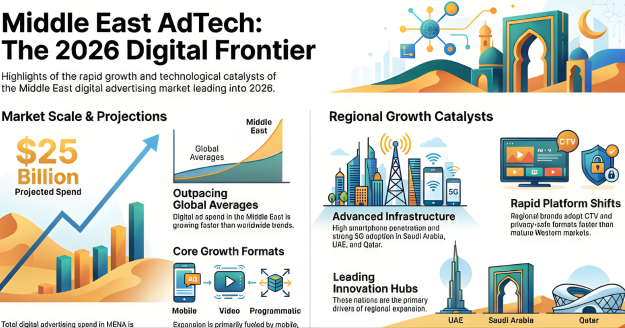
The Middle East has become one of the fastest-growing digital advertising regions in the world. Brands are no longer experimenting with digital media here. They are scaling aggressively across mobile, video, connected TV, and programmatic platforms.
As we move into 2026, advertising in the Middle East looks very different from even two years ago. Audiences consume content across smart TVs, mobile devices, apps, and operating system-level environments. Governments enforce stronger data privacy rules. Platforms reduce access to user identifiers. At the same time, brands demand performance, transparency, and measurable growth. This shift has pushed AdTech from a support function to a core business driver.
This article explains the most important AdTech trends shaping digital advertising in the Middle East, how leading brands use them today, and what advertisers should prepare for between 2026 and 2030.
Middle East AdTech Market in 2026
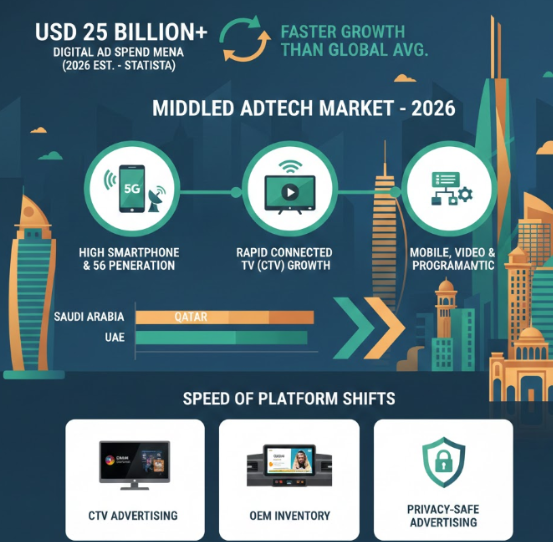
Digital advertising spend in the Middle East continues to grow faster than global averages. According to Statista, digital ad spend in the Middle East and North Africa is expected to cross USD 25-30 billion by 2026 to 2030, driven mainly by mobile, video, and programmatic formats.
High smartphone penetration, strong 5G adoption, and rapid connected TV growth in countries like Saudi Arabia, UAE, and Qatar fuel this expansion.
What makes the Middle East unique is not just growth. It is the speed of platform shifts. Brands here move faster toward new formats like CTV, OEM inventory, and privacy-safe advertising than many mature Western markets.
Growth of Programmatic Advertising in the Middle East
Programmatic advertising now drives the majority of digital media buying across the Middle East. Brands increasingly rely on programmatic platforms because they deliver speed, control, and measurable outcomes at scale.
Advertisers prefer programmatic buying due to its ability to offer:
- Real-time bidding and continuous optimisation
- Strong cost and budget control
- Scalable reach across multiple digital formats
- Transparent, data-driven performance tracking
According to PwC Middle East, programmatic already accounts for over 70 percent of display and video ad spend across key Gulf markets, reflecting how deeply automation has reshaped regional media buying strategies. By 2026 to 2030, programmatic advertising extends far beyond traditional websites. It now powers media buying across:
- Mobile in-app environments
- Connected TV and OTT platforms
- Digital out-of-home (DOOH) networks
- On-device and operating system–level placements
This evolution positions programmatic advertising as the core infrastructure of digital advertising in the Middle East, enabling brands to reach audiences consistently across screens while maintaining efficiency, transparency, and scale.
AI in Digital Advertising: How Brands Are Using It Today
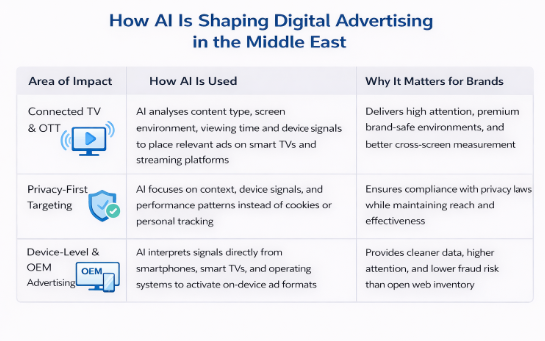
AI has become the backbone of digital advertising in the Middle East. Brands no longer use AI just to automate campaigns. They rely on it to make real-time decisions across bidding, placements, creative delivery, frequency control, and performance optimization. AI systems process millions of signals every second and adjust campaigns instantly, helping brands scale efficiently without manual intervention. Below are three major shifts that define how AI is used today across the region.
Connected TV and OTT have become especially important in markets like Saudi Arabia and the UAE, where smart TV adoption is high, and viewer engagement remains strong. AI-driven programmatic buying helps brands manage frequency, optimise creatives, and control budgets across large screens and mobile devices.
At the same time, the decline of third-party cookies has accelerated the shift toward privacy-first advertising. Instead of tracking users across websites, AI evaluates the environment where an ad appears and learns from aggregated performance signals. This approach improves trust and long-term scalability while delivering consistent results.
Device-level and OEM advertising further strengthen this model. Closed device ecosystems offer reliable signals without exposing personal data, making them ideal for AI-led optimisation in mobile-first Middle Eastern markets.
Top 6 AdTech & MarTech Companies in the Middle East (2026)
1. Google Display & Video 360 (DV360)
Google Display & Video 360 remains one of the most widely adopted programmatic platforms in the Middle East due to its deep integration with YouTube, Display, Search, and Google’s broader advertising ecosystem.
Across GCC markets, Google platforms collectively reach over 90% of internet users, making DV360 a preferred choice for brands seeking large-scale reach and cross-channel measurement. The platform’s AI-driven bidding and brand safety controls help advertisers manage high-volume campaigns efficiently, particularly across video and CTV inventory tied to YouTube.
DV360 performs best for brands prioritising scale, visibility, and ecosystem-driven efficiency.
2. Amazon DSP
Amazon DSP plays a growing role in Middle Eastern digital advertising, especially for retail, e-commerce, and performance-focused brands. Amazon platforms serve millions of active users across the UAE and Saudi Arabia, supported by rapidly expanding regional e-commerce adoption.
Amazon DSP leverages first-party shopping and intent data, helping advertisers reach audiences closer to purchase. Brands often see 15–25% stronger conversion efficiency when using Amazon DSP for lower-funnel objectives compared to generic display buying.
The platform works best when paired with broader brand campaigns on CTV or open-web platforms.
3. Xapads Media
Xapads Media is a global marketing solutions and AdTech company specialising in AI-driven programmatic advertising across mobile, Connected TV (CTV), web, and in-app environments. Founded in 2007, Xapads operates across India, the Middle East, Southeast Asia, Europe, and North America, supported by a 250+ member global team.
Xapads reaches 1.9+ billion users every month through 75,000+ publishing and app partners, giving it one of the largest scalable programmatic footprints among independent AdTech platforms. A key differentiator is its direct OEM and device-level integrations with major manufacturers, enabling advertising at the operating system and device interface level.
In Middle Eastern markets, this results in:
- Higher attention rates (20–30% above open web benchmarks)
- Significantly lower fraud exposure
- Privacy-safe targeting without cookies
- Strong performance across CTV, mobile-first, and smart device ecosystems
Xapads is particularly effective for brands seeking premium inventory, high-attention environments, and scalable cross-market execution, making it one of the most advanced independent AdTech platforms operating in the region.
4. InMobi
InMobi is a mobile-first advertising platform with a strong footprint across emerging markets, including the Middle East. Globally, InMobi reaches over 1.5 billion mobile users, delivering billions of in-app impressions daily.
With mobile accounting for 70–80% of digital consumption across many Middle Eastern markets, InMobi is commonly used for app installs, mobile engagement, and performance-led campaigns. Its strength lies in mobile scale and reach rather than premium CTV or operating-system-level placements.
5. Affle
Affle is a consumer intelligence and mobile advertising platform focused on conversion-driven advertising models. The company operates in 20+ countries and processes millions of intent signals daily to optimise outcome-based campaigns.
In the Middle East, Affle is frequently used by fintech, gaming, and app-based services, where advertisers prioritise measurable actions such as installs, sign-ups, or transactions. Campaigns on Affle typically emphasise cost-per-action efficiency over large-scale brand storytelling.
6. Silverpush
Silverpush is an AI-powered contextual advertising platform specialising in video and CTV intelligence. Its technology analyses millions of video frames per day, identifying objects, scenes, keywords, and sentiment to enable precise contextual targeting.
In Middle Eastern markets, Silverpush is increasingly adopted for privacy-safe video advertising, particularly across OTT and premium CTV environments. Brands use it to improve brand safety, contextual relevance, and engagement, especially as cookie-based targeting declines.
How Middle Eastern Brands Are Running High-Performance Ad Campaigns
Middle Eastern brands focus on efficiency, scale, and compliance to drive strong advertising results. Instead of relying on isolated tactics, they build structured, performance-led media strategies.
What high-performing brands do differently:
- Use multi-channel reach across mobile, video, Connected TV (CTV), and on-device environments to stay visible across screens
- Rely on AI-driven programmatic buying to automate bidding, optimise placements in real time, and shift budgets based on performance
- Adopt privacy-first targeting by focusing on content context, device signals, and viewing environments instead of user tracking
- Invest in premium and brand-safe inventory, including CTV, OTT platforms, and direct device-level placements
- Measure beyond clicks, tracking attention, engagement time, and cross-screen impact to understand real business outcomes
By combining automation, premium inventory, and smarter measurement, Middle Eastern brands turn digital advertising into a predictable performance engine. Those who align technology with a clear strategy consistently outperform competitors in scale, efficiency, and long-term growth.
Key Challenges Brands Face in AdTech Adoption
AdTech offers powerful tools, but new brands often struggle to use them effectively at the start. The challenge is rarely the technology itself. It usually comes from limited experience, unclear strategy, and fast-changing digital environments. In the Middle East, where platforms, formats, and regulations evolve quickly, these gaps become more visible.
Common challenges new brands face include:
- Complex platforms and steep learning curves: Programmatic tools, DSPs, and CTV platforms require technical understanding. New brands often find it difficult to set up campaigns correctly without expert support.
- Limited access to quality data and inventory: Without strong first-party data or premium supply access, brands rely on open exchanges, which can reduce performance and increase waste.
- Unclear measurement and attribution: Many new advertisers struggle to understand which channels or formats actually drive results, especially across mobile, video, and CTV.
- Privacy and compliance uncertainty: Data protection rules and platform restrictions make it hard for new brands to adopt targeting strategies confidently.
- Budget inefficiency during early testing: AI systems need time and volume to learn. Brands that pause or change campaigns too quickly often miss long-term performance gains.
- Creative fatigue and low engagement: Running static or repetitive creatives limits AI optimisation and reduces attention, especially in video-first environments.
In short, new brands succeed in AdTech when they focus on clear goals, patient testing, trusted partners, and strong creative strategy. With the right setup, these early challenges turn into learning advantages that support long-term growth.
What Brands Should Look for in an AdTech Partner in 2026 and Beyond
Digital advertising spend in MENA is projected to reach around $20-$25 billion in 2026, with programmatic advertising at $21.63 billion—growing rapidly as AI-driven and mobile-first buying dominates budgets. For brands, selecting an AdTech partner is a strategic revenue driver amid this expansion.
Prioritise partners with AI for bidding, targeting, creative optimisation, and allocation, as programmatic grows at 7.89% CAGR to $31.62 billion by 2031 in MEA. AI integration boosts efficiency in mobile-first markets like GCC states, where 70% of UAE shoppers use AI assistants.
Demand contextual, first-party, and device signals to navigate cookie phaseouts and tightening laws; telco-led identity graphs in Africa enable deterministic matching without third-party data. This ensures compliance and scale in fragmented regulations across MEA.
Focus on CTV/OTT and DOOH access, with CTV growing at 13.98% CAGR due to 65% daily streaming in the UAE and shoppable overlays boosting engagement. These channels merge TV/digital budgets for premium outcomes like higher attention scores.
By 2031, AI and programmatic will handle most MEA ad decisions via automation and real-time bidding (44% market share). Early alignment with robust partners optimizes costs and captures growth in this maturing market
Conclusion
AdTech in the Middle East has entered a results-driven phase. By 2026, AI, programmatic buying, Connected TV, and privacy-first advertising will define how brands grow in a region where digital ad spend is already worth tens of billions of dollars.
The winners will not be the brands chasing every new trend, but those partnering with platforms that deliver transparent performance, premium inventory, and scalable technology. As automation increases and budgets rise, the real advantage will come from smart execution, trusted data, and long-term strategy.
For brands and advertisers, the message is clear: adapt early, invest wisely, and work with AdTech partners built for the future not the past.