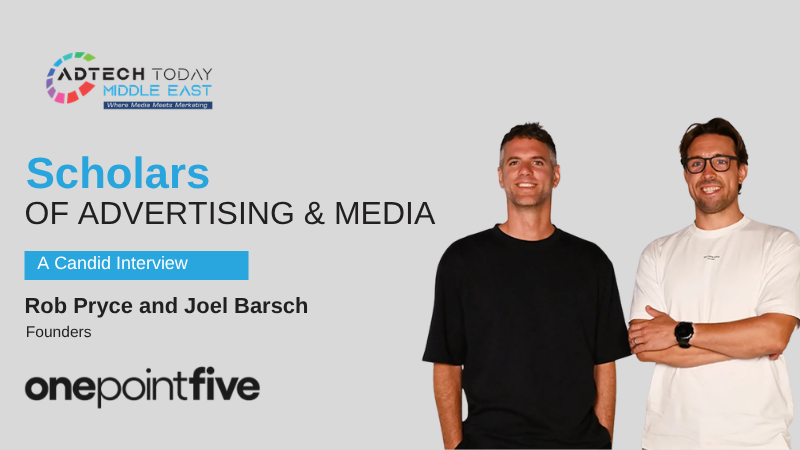
Rob Pryce and Joel Barsch, founders of onepointfive, bring decades of experience shaping brand experiences around the world. While they have long mastered the mechanics of experiential marketing, their focus today is increasingly human.
In a digital landscape saturated with content, the challenge is no longer simply capturing attention but creating a genuine connection.
For Pryce and Barsch, technologies like AI are not a threat to creativity but powerful accelerators. By handling data and personalisation, they allow teams to focus on what matters most: designing meaningful, real-world experiences that bring people together and build trust.
From your perspective, what are the biggest shifts happening in brand experience and experiential marketing globally right now?
“Experiences are no longer an add-on; they now sit at the heart of how brands earn attention and trust.”
In a world saturated with digital content and a rising distrust in what people see online, largely due to the rapid development of AI, live experiences have become the most credible and meaningful way to cut through. This is especially true for Gen Z and Gen Alpha; they value active participation over passive consumption.
At the same time, the old B2B and B2C divide has effectively dissolved. We are now operating in a single attention marketplace. Audiences expect the exact same creativity, usefulness, and emotional value whether they are at a consumer pop-up or a global industry conference.
And lastly, sustainable credentials are no longer a point of difference or something to shout about. Brands expect lower-impact materials, modular builds, and smarter, reuse-driven production models as the absolute standard rather than just a nice-to-have.
How are client expectations evolving when it comes to measuring the effectiveness and ROI of live and experiential marketing?
“ROI is no longer something assessed after the event; it’s a conversation that begins at the brief stage.”
Client expectations around measuring experiential marketing have evolved dramatically. Brands expect measurement frameworks to be embedded from day one, with clear KPIs that shape the creative rather than retrofit it. This shift reflects a broader demand for more accountability, more clarity, and a more direct connection to business outcomes.
Critically, clients are redefining effectiveness through a dual-lens approach. They want to recognise both the commercial outcomes and the human influence shaped by powerful experiences. It’s no longer enough to report simple volume indicators like footfall or impressions; brands want to understand how an activation contributes to qualified leads, pipeline momentum, sales conversations, and earned reach. They also need to see the less tangible behavioural shifts in brand perception, advocacy, and connection that experiences uniquely create.
Digital amplification has also become central to how ROI is assessed. Clients expect experiences to perform across both physical and digital layers. KPIs for content capture, shareability, influencer integration, social reach, and PR coverage must now be built in from the outset. In short, experiential is now judged by its ability to create measurable, multichannel impact, not just memorable moments.
What makes an experience commercially effective today—not just creatively impressive?
“When those elements are baked in early, the experience becomes an engine, not just an event.”
A commercially effective experience starts with complete clarity on the overall business objective. Whether the goal is driving qualified leads, accelerating conversations, or simply increasing brand awareness, the commercial ambition needs to shape the creative from day one.
Today, the experience itself is only half the story; the most successful work has multi-channel amplification woven in from the very beginning. We are talking about the pre-comms that build anticipation, the content you plan to capture onsite, the influencer or talent involvement that feels authentic, and the PR angle that gives the activation life well beyond the moment.
Commercial effectiveness also comes from making any data capture feel natural, not forced. Value-exchange moments that earn consent, like personalized content, product trials, or exclusive insider access, help turn engagement into something actionable without breaking the flow.
And practicality matters too. Modular, rescindable assets and adaptable kits mean the idea can travel, scale, and deliver ROI across multiple markets. Underpinning all of this is operational excellence: great staffing, thoughtful training, contingency planning, and a seamless guest journey. Creativity might capture attention, but flawless delivery is what turns it into real commercial impact.
Why has the Middle East become such an important and fast-moving market for experience-led marketing and brand environments?
The Middle East has become one of the most exciting and fast-moving regions for experience-led marketing because the audience, culture, and commercial landscape all point in the exact same direction. You have a young, mobile-first population with high spending power and an appetite for luxury, entertainment, and newness.
“These aren’t passive consumers; they’re socially driven, globally connected, and constantly seeking out things to do, not just things to watch.”
Crucially, the region is built on live culture. People here watch significantly less traditional TV than in Western markets; instead, they lean heavily into real-world experiences like sport, music, festivals, malls, nightlife, and hospitality. That behavioral baseline naturally fuels demand for immersive brand moments.
Add to that the region’s incredible scale and ambition. Tourism continues to surge, premium retail keeps expanding, and markets like the UAE, Saudi Arabia, and Qatar consistently invest in world-class infrastructure. Major spectacles, from Formula 1 and the FIFA World Cup to Expo 2020, have normalized blockbuster experiences as part of everyday culture, which ultimately raises expectations for brands.
All of this creates a perfect storm: an audience hungry for experiences, and a market determined to deliver them at a global benchmark.
What separates short-term “stunt” thinking from longer-term experience strategy, and why does that distinction matter more now?
The biggest difference between a short-term stunt and a longer-term experience strategy is intent. A stunt is traditionally designed to spike attention, clicks, and a quick cultural moment, but it rarely ladders back to a broader brand or business ambition. A strategic approach looks very different. We never view an experience as a singular execution; we are thinking about what it unlocks next, how it ladders into a six or twelve-month plan, and what legacy it creates for the brand.
This longer view also creates commercial efficiencies. Planning experiences as part of a sustained programme, rather than isolated moments, reduces production costs, streamlines creative development, and avoids reinventing the wheel every time. It also enables an always-on ecosystem of community and content that extends the impact far beyond event day. Ultimately, the distinction matters more now because brands are under pressure to demonstrate outcomes, not just outputs.
“A stunt might generate impressions, but a strategy drives revenue, retention, brand equity, and repeat engagement, proving the value of experiential in a way that lasts.”
Looking ahead, what capabilities do agencies and brand teams need to build to stay competitive in experience-led marketing?
Looking ahead, the agencies and brand teams that will win in experience-led marketing are those building capabilities that reflect how audiences actually move through the world. That starts with a firm shift to B2P, or Business to Person. This is a concept developed by onepointfive that recognizes all brand experiences now compete in a single shared attention marketplace, where category matters less than human relevance. It means designing experience-led ideas that connect with people first, not segments. And you have to plan around real human journeys that span physical, digital, and media touchpoints rather than channel silos. To deliver that well, agencies and brands need deeper service design and journey-mapping capability built into the process from the very start.
Agility is also becoming essential. The pace of change across culture, technology, and consumer behaviour demands teams who can flex around shifting requirements; this is exactly what our own ways of working are built on.
“And while AI is reshaping experience design, the advantage lies in using it well: as a creative accelerator, a way to deepen personalisation, or a tool for smarter data capture, and not as a gimmick.”
We also need longer-term planning, so sustainable principles can be baked in from the very start. This encourages modularity, reusability, and the use of lower-impact materials that reduce footprint and improve cost efficiency across multiple activations. And for brand teams specifically, one of the biggest shifts is organisational. You have to bring the brand experience agency into the conversation early so strategy, comms, and creative are aligned. That way, the experience channel isn’t an afterthought but a driver of long-term brand value.