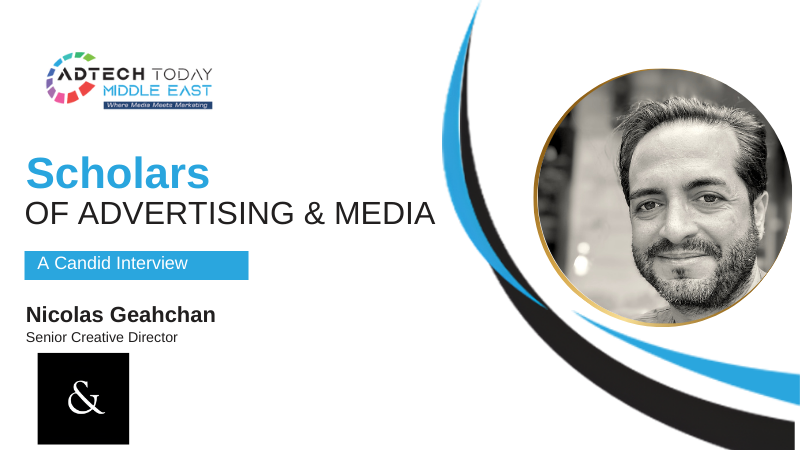
Nicolas Geahchan has spent over twenty-five years working in global agencies across the EMEA region. He is the Senior Creative Director at Saatchi & Saatchi MEA, mastering the art of the “Lovemark”—the idea that people can truly fall in love with a brand. Today, he’s leading his teams through a world of AI, data, and 6-second ads, but he isn’t running away from the technology. In fact, he’s a big believer in it. For Nicolas, the secret to modern creativity is using math to ground the work and “magic” to finish it. In this interview, he talks about why he still fights for the messy human moments in a digital world and how he’s helping Saudi youth see their own reflections in the brands of the future.
Saatchi & Saatchi’s heritage is built on Lovemarks, loyalty beyond reason. How do you maintain emotional depth when today’s primary consumer canvas is a fleeting 6-second vertical video or a skippable ad?
Lovemarks has always been built on one simple truth: love. And love never depended on having 30 seconds or a big cinematic canvas. Emotional depth isn’t a question of duration; it’s a question of intention. Creativity, when it’s honest and human, can make you feel something in one second, in one frame, in one gesture.
“Today’s formats don’t diminish emotion. They challenge us to distill it.“
To express more with less and find the human tension that cuts through instantly. We live in a world obsessed with dashboards, predictions, and percentages. But eventually you reach a point where you realise: data can tell you what people do, but there is no love in data. The love comes from creativity, from the leap, the insight, the craft.
So, maintaining emotional depth today isn’t about fighting the canvas; it’s about mastering it. Creativity hasn’t lost its power to move people. If anything, it’s being asked to prove its purity.
You have spoken about how AI can make creativity solitary. As a creative leader, how do you encourage teams to use Generative AI for efficiency while preserving the “messy,” collaborative human friction that often leads to the best ideas?
I’m a big believer in AI; it has genuinely elevated the quality and efficiency of our work. It handles the heavy lifting, the repetitive tasks, and the hours lost on execution. That’s a gift I wish we’d had earlier, as it gives creatives more time to think, to refine, and to push boundaries.
But AI, by its nature, tends to create things perfectly, cleanly, as they “should’ be. It thinks inside the box because it is built on what already exists. Real creativity—the kind that surprises you, challenges you, or even scares you a bit—almost always comes from the opposite. It comes from the imperfect, the weird, and the unexpected leap no dataset could ever predict.
That’s why I fight to keep the messy, human part of the process alive. An in-person brainstorm—with all its energy, tension, tangents, and laughter—is where out-of-the-box thinking actually flourishes. That is where ideas collide, contradict, provoke, and suddenly spark into something new. You simply cannot replicate that with a prompt.
For me, the formula is simple:
“Use AI for what accelerates the work, and use humans for what elevates the work.“
When teams learn to balance the efficient with the unpredictable, that’s when the best ideas happen.
The cultural narrative in Saudi Arabia has shifted dramatically in recent years. As a Creative Director, how do you navigate the balance between respecting deep-rooted heritage and reflecting the hyper-modern, globalised reality of Saudi youth today? How do you ensure your work feels authentic to this “new” culture without falling back on legacy tropes or stereotypes?
I always like to challenge the premise of that question because Saudi youth aren’t torn between heritage and modernity. They’re not choosing one over the other. They’re proving that you can be hyper-modern, global, and ambitious—and still be deeply rooted in who you are. They carry their culture with pride; it just manifests in new expressions and new aesthetics. They never let go of their identity.
So, the job isn’t to ‘balance’ two opposing forces. The job is to reflect the truth of who they already are.
“When a brand talks to Saudi youth, it doesn’t need to choose between tradition and modernity; it needs to understand how naturally those two things coexist.”
It’s about how they behave, how they create, how they celebrate, and how they evolve. Authenticity comes from showing that duality without exaggeration, or clichés. It’s about capturing real behavior, real language, and real context. If you listen closely to the new Saudi culture, you realise it’s not about reinvention; it’s about self-confidence. Any work built from that truth will always feel authentic.
There is ongoing debate around “Math” (data) versus “Magic” (creativity). Rather than seeing them as opposing forces, how does data fit into your creative process—does it act as a springboard for new narratives, or primarily validate creative intuition?
For me, the ‘Math vs. Magic’ debate is a false one. Data doesn’t drive creativity, but it shapes the context in which creativity can shine. It gives you the borders of the playground: the tension and the opportunity—and then creativity fills that space with meaning.
So yes, the process should start with data. It shouldn’t dictate the idea, but it must ground it. It’s about knowing where the audience really is, what motivates them, and what truth we can build on. That’s the springboard. The process should also end with data- not to ‘judge’ creativity, but to validate its impact. We need to understand what moved people and what shifted behavior; that’s how work evolves and gets sharper.
But the creation itself, or what I call the ‘messy middle’, that’s where creativity needs freedom. That’s the moment where logic steps back and imagination takes over. It’s the only space where magic actually happens. If data controls that stage, you get predictable work. If creativity is allowed to breathe, you get ideas that truly cut through. For me, it’s simple: data frames the journey, creativity elevates it.
“ Start with Math, end with Math, but let the Magic happen in between.”
The “New Saudi” creative scene is seeing a surge of digitally native talent. When mentoring Gen Z creatives who are fluent in tech, what is the one fundamental “old-school” craft skill you still insist they master?
First, let me say this very clearly: in today’s adland, regardless of your seniority, if you’re not fluent in tech, you simply won’t survive. The pace, the tools, the platforms, the expectations—they all evolve daily. As a senior creative, you have to stay curious, keep learning, and sometimes even learn from the juniors who grew up natively in this space. That humility is essential.
“There’s one ‘old-school’ craft I insist they master: the ability to defend their ideas—to fight for them, refine them, and truly own them.”
When you spend time thinking, shaping, and crafting an idea, you build a relationship with it. You know its strengths, you see its weaknesses, and you understand exactly how far it can go.
Today, because tech makes creation so easy, there’s a temptation to move on too quickly instead of pushing one great idea further. But great ideas—the ones that actually last—need conviction. They need someone to champion them. They need someone who believes in them enough to stand up for them.
With the rise of gaming, AR, and immersive commerce in the GCC, where do you see the biggest untapped creative opportunity? If you had an unlimited budget, what kind of experience would you build to meaningfully connect with Arab youth?
If I had an unlimited budget and unlimited time, I wouldn’t chase the next AR stunt or the newest shiny piece of tech. I’d build a world—something on the scale of a ‘Grand Theft Auto’ universe, but without the violence or the shock value.
“I envision an immersive open-world experience that mirrors how Arab youth actually live, behave, create, and connect.”
The untapped opportunity isn’t a new technology; it’s giving Arab youth a digital space that truly reflects them, rather than a borrowed aesthetic from somewhere else. It would be a place where their humor, ambition, social dynamics, and contradictions can exist authentically, without being filtered or simplified.
Imagine a living, breathing virtual city shaped by the region’s energy—where you can build businesses, create content, and explore your identity. In this world, brands don’t interrupt the experience; they naturally become part of the economy, the narrative, and the environment. Gaming, AR, and immersive commerce all converge in this culturally grounded, human-centered universe. Would any brand invest over a billion dollars and wait six years to bring it to life? Highly doubtful. But hey—you said unlimited budget.”