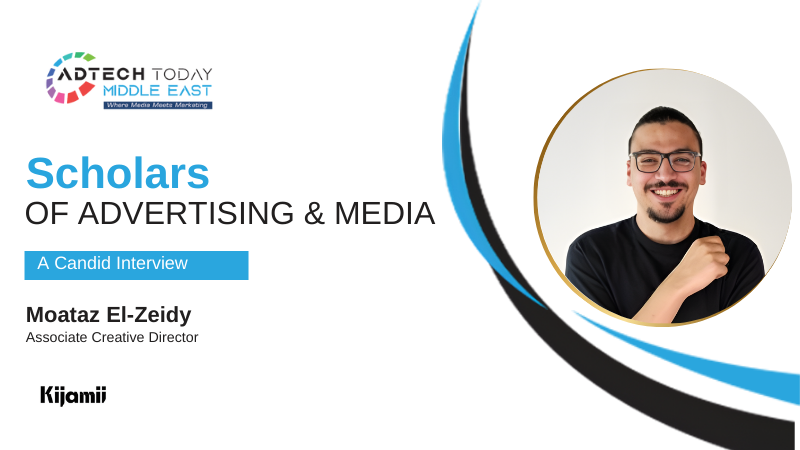
Moataz M. El-Zeidy doesn’t see data and creativity as rivals; to him, they are “best friends.” As Associate Creative Director at Kijamii Saudi Arabia, Moataz brings over a decade of hands-on experience—from the technical trenches of design and execution to leading regional teams across the Middle East.
He is a big believer in the power of tech, but he doesn’t see AI as a replacement for a good idea. Instead, he uses it to improve efficiency and exploration, so his team can focus on thinking, creative quality and craft..In a world of fast data and vertical video, Moataz is making sure that every campaign still has a soul. From flipping the script on category clichés to navigating the “confident creator” mindset of modern Saudi Arabia, he is redefining how brands can speak with a soul while performing with precision.
Every creative leader has a unique origin story. Could you walk us through the pivotal moments in your career that led you to your current role as Associate Creative Director at Kijamii?
My journey kicked off with a simple discovery—an absolute love for art and advertising. For seven years, starting in 2011, I dove into every corner of the process: design, copywriting, animation, 3D, and even directing. That hands-on experimentation became my foundation. It gave me this rare advantage—the ability to not just think in ideas, but to truly understand the craft and execution required to bring a concept to life.
A defining chapter was building a startup’s creative team from scratch; I wasn’t just shaping the output, I was building the operations and the culture itself. Then came Kijamii, and with it a larger regional environment that pushed me to think beyond a single market. Working across diverse landscapes—from Morocco to Yemen—sharpened my ability to adapt storytelling to specific cultural nuances and business goals.
But the real shift happened when I stepped into leadership. I moved from being a creator to owning the full process; I wasn’t just making work anymore, I was building environments where people could grow. For the last six years, my focus has been Saudi Arabia. Today, I lead multidisciplinary teams to create work that is culturally grounded, emotionally human, and—above all—designed to perform.
Kijamii’s philosophy is “Work That Works” —a blend of creativity and performance. From a creative director’s lens, how do you balance the artistic urge to tell a beautiful story with the pragmatic need for data-driven results?
The balance starts by treating every brief as both a creative opportunity and a business challenge; you always have to ask what the objective is. Is it awareness, consideration, or conversion? What does success look like in real KPIs? From there, you build the story—but you tie that narrative to how people actually behave. We look closely at audience behavior, platform context, and how content is consumed in a scroll-first world. It’s a formula that’s both simple and incredibly difficult, but it’s what sharpens the storytelling and ensures we capture attention.
“To me, data and creativity aren’t enemies—they’re best friends.”
When a concept is built on real consumer insight, the narrative becomes clearer and far more persuasive. Performance signals then guide the execution—the hooks, the pacing, the messaging hierarchy—but my role is to ensure that “optimization” never turns the work into a generic template. You have to protect the core idea while keeping the execution agile. That’s how you build work that speaks the language of creativity but performs like a product.
The Saudi consumer mindset has shifted dramatically, often described now as the “confident creator.” How has Vision 2030 influenced the way you conceptualize campaigns for the local market compared to five years ago?
Vision 2030 didn’t just reshape infrastructure; it reshaped identity. Saudis today are expressive and ambitious—they are actively shaping culture. Five years ago, campaigns leaned on “safe” messaging, but today, the expectation is different- bold, relevant, authentic and culturally intelligent. To me, cultural intelligence isn’t about over-referencing local cues, but it’s about doing your homework and knowing the culture deeply enough to use it naturally. It should feel effortless; when it’s forced as a creative shortcut, the audience feels it immediately.
“The biggest shift is moving from consumer as receiver to consumer as creator.”
People don’t just watch content—they remix, judge, and respond to it. This is why campaigns now require participation built in, social-first storytelling and creator collaborations designed for conversation. Saudi audiences are increasingly design-aware; they reward originality and spot clichés instantly. The challenge today—and what excites me most—is building ideas that feel locally rooted yet globally modern. We are crafting work from real Saudi life, but delivering it in a platform-native way that meets the world’s highest creative standards.
You recently worked on the Ring campaign, “Keeping You Close to What’s Important.” where you flipped the script from “security and fear” to “warmth and connection.” Can you take us behind the scenes of that decision?
With Ring, the easy route would have been the classic “fear-based” narrative—break-ins, danger, and tension. But we knew that wouldn’t reflect the emotional truth of the Saudi audience. In this region, protection is less about paranoia and more about care—an insight backed by Kijamii’s Consumer Insights team. We flipped the script toward warmth, making security feel human and part of everyday life. Creatively, we centered on three characters: a working mom, a businessman, and a
gamer. We built the story on a simple contrast—the unease of the unknown versus the reassurance of connection. This gave us a relatable way to show the product in action without it feeling forced. Features like Live View and Two-Way Talk became tools for presence, like watching your kids arrive home or speaking to them instantly
By dramatizing closeness instead of fear, we avoided category sameness while landing our product RTBs. It created a memorable, brand-building narrative that fits Saudi life naturally.
With AI becoming a central tool in Kijamii’s “Powered by AI” ethos, how do you see the role of a Creative Director evolving?
AI is changing the pace of the creative process, but not the purpose. At Kijamii, it helps us move faster in those messy early stages; visualizing directions, testing multiple routes, building rough storyboards, and generating content variations before we ever commit to production. That speed is a gift. It gives us more room to explore and makes our creative decisions much smarter.However, in this AI-driven landscape, the Creative Director’s role becomes more critical, not less. When production becomes “easy,” taste, judgment, and intention become the real differentiators. AI can generate dozens of options in seconds, but it can’t tell you which one is true to the brand or aligned with a specific cultural nuance. It doesn’t understand emotional weight or long-term brand integrity.
For me, the job now is to protect the soul of the work and ensure it feels human, not
automated. We use AI to open possibilities, then rely on experience and instinct to choose, refine, and focus.
“AI helps us move at the speed of the market, but it’s still our responsibility to ensure what we put out into the world actually matters.”
As we look toward the future of adtech and creativity in the Middle East, what is one trend or skill set you believe will define the next generation of creative talent in Saudi Arabia?
The Saudi market is moving fast, and audiences are sharper than ever; work can’t rely on craft alone, and it certainly can’t hide behind corporate strategy language. It has to do both.
“The skill set that will define the next generation is this: a creative who thinks like a marketer and executes like a creator.”
Thinking like a marketer means starting with the “why”—the objective, the audience tension, and the product truth. But it also means taking ownership of performance. It’s about knowing how to turn an idea into measurable impact—driving stronger engagement, higher consideration, or real brand lift. It’s the ability to connect creativity to numbers without losing the soul of the idea.
Executing like a creator means bringing that logic to life in a way people actually want to watch and share. It’s about building ideas that can scale across formats while staying fresh and relevant. In Saudi Arabia, the winning creatives will be those who connect brand ambition with real human behavior—delivering work that feels intentional, effective, and above all, real.