We used to think of “shopping online” and “going to the store” as two different things. But today, those worlds are merging.
Leading this change is Mazen Mroueh, Publicis Media’s Head of Performance & Operations. He isn’t just watching the trends, but actively building the technology behind them. From spending nine months orchestrating the region’s first programmatic in-store ads to creating frameworks that allow banks and car brands to use shopper data, his expertise is reshaping how the Middle East buys and sells.
In this candid interview, Mazen explains how technology is finally connecting what we see on our phones with what we buy on the shelf. He shares a clear vision for 2026: a future where data makes shopping smarter, and where the gap between social media trends and physical stores disappears completely.
In one sentence, how do you define commerce media as it stands today in the Middle East?
Commerce media in the Middle East today is the region’s next operating system for growth; it brings retailer data, consumer intent, and media activation closer together, with measurement evolving rapidly behind it.
The Advertima partnership at Carrefour has introduced real-time, verified audience buying to physical stores. How is this capability influencing the convergence of traditional Trade Marketing budgets and Digital Media spending for CPG brands?
For me, this partnership has been a clear inflection point in how CPGs view physical retail. Real-time, verified audience buying is finally breaking down the long-standing separation between “trade” and “digital” by proving that in-store media can behave with the same precision and accountability as online channels.
The AI-driven computer-vision layer at Carrefour, validated by the Sensodyne activation, showed us how dynamic creatives mapped to real shopper demographics can drive impulse, increase sales, and triple efficiency and effectiveness.
“While budgets aren’t fully shifting from trade marketing to digital just yet, the conversations are absolutely changing.”
Trade, commerce, and retail-media teams are planning closer together, aligning more often, and recognizing that the future sits in a more unified approach.
With the rapid expansion of Retail Media Networks across MENA, what steps are being taken to establish a unified measurement framework that allows brands to compare ROI across different retailers?
We’re building measurement the same way you build trust with transparency, common definitions, and proof that holds up even when no one is watching.
“Across the region, Publicis, IAB Retail, and several leading retailers are aligning on standardised attribution windows, unified incrementality methodologies, and shared taxonomies for metrics like ROAS, uplift, and match-rates.”
Clean rooms, cross-retailer collaboration, and the technical expertise we’re developing within Publicis are becoming the backbone of this effort. It’s not fully harmonised yet, but 2026 will be the year we see the first MENA-wide blueprint start to take shape.
With the success of the Haleon/Sensodyne activation, you’ve proven that in-store media can be programmatic. As we look toward 2026, do you see ‘Physical Retail’ becoming just another placement option inside DSPs, or will it remain a specialised direct buy?
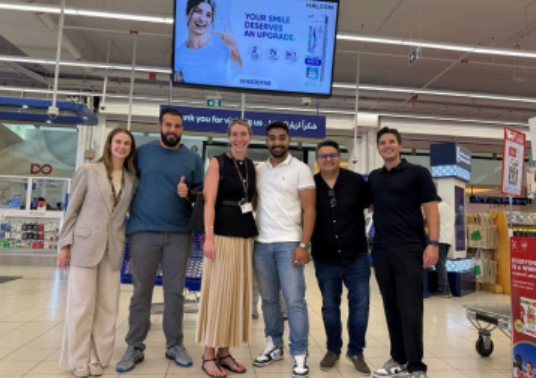
“The Sensodyne activation is personal to me because I spent more than nine months bringing global, regional, and local teams together across different companies and functions to make it happen.”
It proved something I’ve believed for a long time: physical retail doesn’t have to follow digital innovation; it can shape it. By 2026, I fully expect physical retail to live inside DSPs as a natural extension of omnichannel planning. The retailers who will win are the ones who move early into programmatic and pair those pipes with rich, exclusive first-party data and a deep
understanding of in-store behavior. So yes, it will sit inside DSPs, but it will still feel like a premium, high-value environment with its own nuances—not just another line item.
Global trends show a rise in ‘non-endemic’ advertisers (e.g., finance or automotive) utilising retailer data. To what extent is this trend materialising in the Middle East, and how are data clean rooms facilitating these partnerships?
“The shift is already here. Banks, automotive brands, telcos, real estate, and travel advertisers are now viewing retailer data as one of the strongest intent signals in the region.”
A big part of this acceleration comes from the strategic vision we’ve been shaping at Publicis by building the foundations, partnerships, and frameworks that allow non-endemics to tap into retailer ecosystems with confidence. Technology and innovation are simply the bridge that makes these partnerships possible.
A clear example is our Landmark partnership. It was designed from day one with a full focus on non-endemics—and in fact, every activation to date has been driven by non-endemic sectors. What’s driving this momentum is the ability to connect data safely and intelligently, enabling brands that historically never collaborated with retailers to target audiences that genuinely fall within their segment.
The potential is huge: non-endemic advertisers can now reach the right shoppers with dynamic messaging, precise targeting, and measurable impact. And in many ways, we’re still only at the beginning of this growth story.
Looking at the 2026 roadmap, do you foresee a deeper integration between Social Commerce (e.g., TikTok Shop) and Physical Retail Media, allowing for a fluid ecosystem where social trends dictate in-store digital display inventory?
Absolutely. This is where the heartbeat of culture meets the rhythm of retail.
Social platforms already shape what consumers crave. The next step is letting those signals dynamically inform in-store media in real time.
“I see a world where a product trending on TikTok in the morning triggers in-store DOOH exposure by the afternoon.”
This fusion tightens the loop between influence, discovery, and purchase—and the retailers who embrace this sync will lead the next wave of commerce media
What is one misconception brands still have about commerce media in the Middle East that you believe will disappear by 2026?
“Many brands still view commerce media as overly complicated—and to be honest, they’re not wrong.”
There are too many platforms, too many signals, and too many walled gardens for it to feel seamless today. But by 2026, this perception will shift as the region moves toward standardization, unified measurement, and far simpler workflows.
A major part of that transition is being shaped by the frameworks and operating models we’re building at Publicis Groupe, alongside the strategic vision I’ve been driving to make commerce and retail media easier, more predictable, and more connected for brands. What feels fragmented now will soon become intuitive and integrated, transforming commerce media into one of the most streamlined and dependable growth levers in the Middle East.