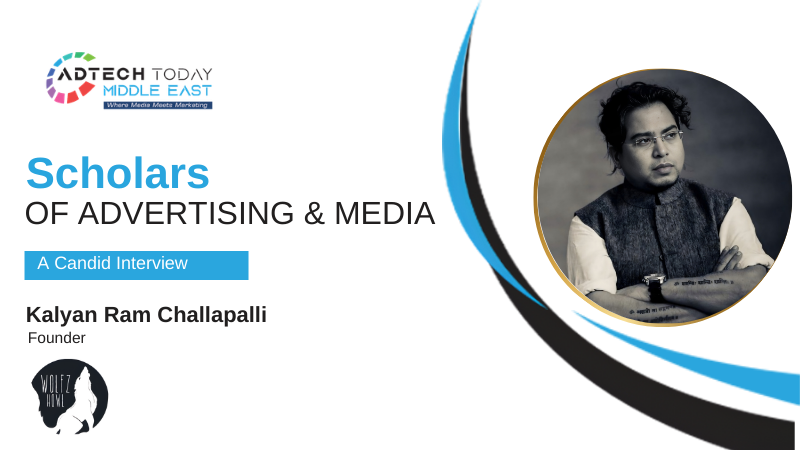
Kalyan Ram Challapalli, Founder of WolfzHowl Global, is a strategist obsessed with the “why” behind the click. After years in senior agency leadership across APAC, he observed a recurring pattern in the UAE: brands investing heavily in sophisticated marketing stacks—CDPs, AI layers, automation, without always defining the business architecture behind them.
In this candid conversation, he explains why the UAE is a consumer “multiverse” that resists copy-paste playbooks, why coherence is the region’s biggest strategic gap, and why Cultural Intelligence—not more software—will define the next generation of competitive advantage
What was the core strategic gap you saw in the UAE market that led you to build a boutique focused on ‘un-templatizing’ marketing and strategy?
When we examined the UAE market closely, the biggest gap wasn’t a lack of ambition or technology. It was something subtler: brands were investing in tools, but not designing for business outcomes.
Across industries, companies were proudly rolling out CDPs and AI layers because that’s what “modern marketing” looks like. But when you peeled the surface, the question “What business problem is this solving?” often didn’t have a clear answer. Technology has become a checklist, not a strategy. The ecosystem was optimised for activity, not advantage.
The performance marketing culture is dominating decision-making. Brands became extremely good at paid media optimisation—tweaking bids, chasing ROAS—but struggling to articulate a brand platform. The result? Rising acquisition costs, shallow loyalty, and creative fatigue. Nothing compounded. Nothing truly belonged to the brand.
Layered onto this is the UAE’s structural complexity. It is a consumer “multiverse,” yet we repeatedly see global templates dropped in with minimal adaptation. Localisation frequently stops at translation or festive calendars. Behavioural segmentation remains basic despite dramatically different motivations, life stages, and cultural contexts coexisting in one market.
There is an advisory gap. Smaller agencies here are agile, but very execution-heavy and strategy-light. They were getting advice from media vendors, tech platforms, and solution sellers. That’s not a neutral strategy; that’s channel-led thinking. Business leaders need partners who can ask: What are we actually building? A campaign engine, or a growth engine? All of this pointed to one underlying truth:
“The real gap is coherence.”
That’s why we are building a boutique focused on “un-templatizing.” You can’t copy-paste growth in a layered market like the UAE. You have to design it around context, behaviour, and business ambition.
The UAE is a global hub for rapid digital and economic transformation. In this high-growth environment, what is the most interesting behavioural shift you’ve observed in how consumers here interact with brands?
The most striking shift is that UAE consumers have become simultaneously more value-driven and more meaning-driven. Today’s shopper speaks the language of offers—bundle deals, buy-now-pay-later, flash sales—but this hasn’t turned the market into a race to the bottom Instead, how a brand structures value signals how well it understands modern lifestyles, cash flow realities, and aspirational identity.
At the same time, loyalty has become fluid. Consumers actively experiment with new brands if the value exchange feels sharper from faster delivery, better bundles, and a smoother digital journey, or a premium-feeling experience at a similar price point. In a market used to constant innovation, switching is normal behavior.
The brands winning today are those that combine emotional resonance with economic intelligence. Digitally, this plays out in non-linear journeys. A customer might discover a brand through a creator, compare prices across platforms, read reviews, wait for a deal alert, and then purchase where the total equation price, delivery speed, payment flexibility, and perceived brand fit feel right.
The real behavioral shift is this: from passive loyalty to active evaluation. Consumers are constantly scanning for better value, but they still commit emotionally, just more selectively.
“In the UAE, the brands that thrive are those that understand that modern loyalty is continually re-earned through relevance, respect, and smart value design.”
You’re known for uncovering ‘human truths’ in strategy. In a market as diverse as the UAE, how do you balance sophisticated data and analytics with the empathy needed to understand what truly drives consumer choice?
In a market as diverse as the UAE, sophisticated data and analytics are essential and readily available, yet they do not tell the whole story. Effective strategy emerges where quantitative segmentation meets behavioural and cultural nuance, with data interpreted to understand patterns and contextualised by human empathy to draw insights.
We combine analytics with firsthand exposure. We spend time with sales teams to hear real consumer conversations. We observe how people ask questions, what confuses them, and what reassures them. In a market shaped by migration, ambition, and constant transition, context matters as much as category.
This is why we segment beyond demographics. Age and income tell you purchasing power, but not their motivations and certainly not their mindset, which also comes from diverse
backgrounds, making it imperative to have an additional layer of ethnographic understanding. For e.g. someone new to the UAE may be in exploration mode, trying brands, building their new lives and someone may be looking for familiarity and financial control. A long-term resident with the same income might be prioritising convenience. On a spreadsheet, they look similar, but they’re in completely different psychological stages. If your strategy doesn’t reflect that, your personalisation is emotionally irrelevant.
“Data is the backbone, but empathy is the driver. That’s how you create strategies that are accurate, authentic, and truly human.”
As automation and AI become standard tools in strategy, what is the one irreplaceable human skill you believe the next generation of UAE-based strategists must develop to stay relevant and competitive?
As AI and automation handle the heavy lifting of data processing and content generation,
“The one irreplaceable skill for UAE-based strategists is Cultural Intelligence or CI or CQ.”
AI can optimize the marketing process, but it cannot navigate the subtle “red lines” of the region or the “golden opportunities” that exist in this diaspora.
“The strategist of the future is not a data scientist, but a Cultural Architect.”
Future leaders must be able to synthesise global trends through a local lens. They need the ability to speak the “language of the region” not just linguistically, but emotionally. In a country where 200+ nationalities interact daily, the ability to build bridges between these cultures is the only way to stay competitive in a landscape that is becoming increasingly automated.
For brands in the UAE’s highly competitive retail and tech sectors, what truly drives long-term loyalty instead of short-term engagement?
As we discussed earlier, this is a market where consumers have endless choices and constant promotional noise. So short-term engagement is easy to buy. Long-term loyalty, on the other hand, is earned when a brand consistently makes life feel smoother, smarter, or more aligned with who the customer believes they are.
What builds loyalty is how reliably a brand shows up beyond the transaction in service recovery, delivery experience, returns, customer care, and post-purchase communication?
“The second driver is value design, not just value discounting.”
Consumers actively look for bundles, flexible payment options, free delivery thresholds, and limited-time drops. When pricing, packaging, and promotions feel intentional and consistent, customers begin to trust the brand’s logic. Long-term relationships are built when customers feel a brand is helping them make smarter choices, not just cheaper ones.
There’s also a powerful emotional layer. This is a transient yet aspirational market where people are building careers, families, and new identities. Brands that recognize milestones, cultural moments, and lifestyle transitions create deeper bonds. A retailer that understands festive cycles across communities, or a tech platform that supports a user’s professional growth, moves from being a provider to being a partner. That emotional continuity is hard to replicate and becomes a key loyalty moat.
Looking ahead to 2026, how will the UAE’s creative and strategic ecosystem evolve—and where can it set global benchmarks?
- By 2026, the UAE’s creative and strategic landscape will shift from being a regional service hub to becoming a global ideas testbed. The country’s diversity, speed of adoption, and policy support create a rare environment where brands, platforms, and creators can prototype new models of commerce, content, and community at scale. Strategy here will become more hybrid, blending data science, cultural intelligence, and experience design because audiences here are too layered for siloed thinking.
- It can set benchmarks for commerce-driven creativity, where branding, content, and conversion are seamlessly integrated. It can lead to creation of multicultural strategy frameworks, showing the world how to build resonance across dozens of coexisting cultures without diluting identity.
This trajectory positions the UAE not just as a regional growth story, but as a world stage for innovation in marketing, strategy, talent mobility and economic architecture.