Advertising in the Middle East has always been visually ambitious, culturally expressive, and fast-moving.
But a new shift that challenges not just how campaigns are executed, but who (or what) creates them. Synthetic creators, AI-generated visuals, voices, and video content are moving from experimental novelty to practical production tools. Their impact on regional advertising will be beyond superficial, changing the very structure of the industry.
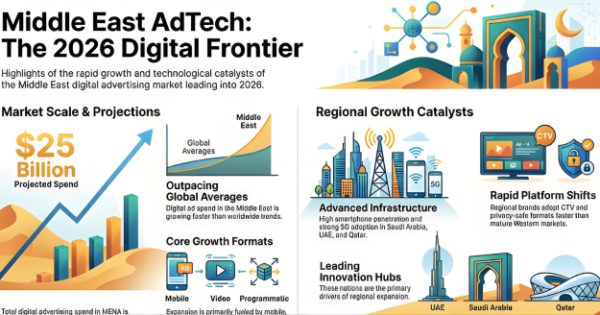
Globally, brands are already responding to rising production costs, shorter attention spans, and the pressure to personalise at scale. The total global advertising in 2026 is forecasted to reach $1.3 trillion at a YoY growth rate of over nine per cent. This is driven largely by creative automation and generative content. The Middle East, with its digitally native population and mobile-first consumption habits, is particularly well positioned to feel this shift early.
From cost efficiency to creative agility
Traditionally, high-quality advertising production required long lead times, location shoots, talent contracts, and multiple agencies. AI-generated production disrupts this model by collapsing time and cost barriers. Synthetic video, voiceovers, and imagery can now be created, localised, and iterated in days rather than weeks.
This matters in a region where campaigns often need to be adapted across languages, cultures, and markets. A single campaign may need Arabic, English, Hindi, Tagalog or Russian variants, each with cultural nuance. AI makes this operationally feasible. Generative AI can significantly reduce content production costs by up to 40% while increasing output. For advertisers, that means budgets can shift from fewer “hero” assets to a wider ecosystem of testable, adaptive creatives. The real advantage is speed, not savings alone.
“AI-generated production allows brands to respond to cultural moments, seasonal shifts, and real-time data signals without waiting for the next production cycle. In advertising, relevance decays quickly, and AI helps close that gap.”
The rise of synthetic creators
Synthetic creators or AI-generated humans that can speak, move, and emote are increasingly used for explainer videos, branded content, and performance advertising. AI could add over $15 trillion to the global economy by 2030, with generative tools like content creation forming an increasingly influential subset.
In the Middle East, synthetic creators offer a unique advantage: consistency with localisation. A single AI persona can deliver messages in multiple dialects, adapt tone for different audiences, and appear across formats without fatigue or scheduling constraints. For sectors like retail, travel, and financial services, where information changes frequently, this flexibility is invaluable.
However, their role is not to replace human storytellers. The most effective use cases position synthetic creators as communicators, not cultural authors. They deliver messages efficiently, while humans still define narrative, values, and creative direction.
Personalisation at scale, without fragmentation
Personalisation has long been the promise of digital advertising, but execution has been limited by production bottlenecks. AI-generated production changes this. Creative elements, backgrounds, product placements, messaging, and even facial expressions can be dynamically adjusted based on audience segments.
Personalised ads can deliver up to a 20% uplift in conversion rates, but only when relevance feels natural rather than intrusive. This is where first-party data and AI play a key role. AI enables this balance by allowing creative variations to be subtle, contextual, and behaviour-led rather than overtly segmented.
In the Middle East, where audiences span tourists, expatriates, and nationals with very different expectations, this capability is particularly powerful. The same campaign can feel premium in one context, practical in another, and aspirational in a third, all without multiplying production teams.
Trust, transparency, and regulation
With scale comes responsibility. Audiences are increasingly aware of synthetic media, and trust will depend on transparency. The World Economic Forum has highlighted synthetic media governance as a key priority, warning that misuse or lack of disclosure could erode consumer confidence.
The region is already taking this seriously. The UAE’s National AI Strategy 2031 emphasises the ethical deployment of AI and human oversight, setting a framework that balances innovation with accountability. For advertisers, this means clear disclosure, consent-led data use, and careful consideration of where synthetic creators are appropriate.
There is also a cultural dimension. Authenticity matters deeply in Middle Eastern storytelling. AI-generated content that ignores local norms, humour, or sensitivities will fail regardless of technical quality. Locally present, human creative judgment remains essential.
Synthetic creators and AI-generated production are not a passing trend. They respond to structural pressures: faster cycles, fragmented attention, and the need for relevance at scale. For Middle East advertisers, the opportunity lies in adopting tools thoughtfully.
Using AI for what it does best, while preserving human creativity, cultural intelligence, and ethical judgment, is the path to take.
Read more: Why Emerging Markets Need Their Own Digital Communications Playbook