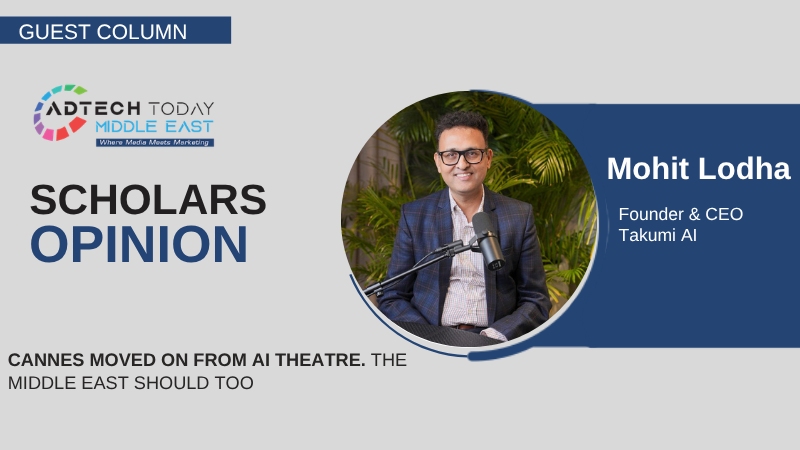
Takumi AI Founder & CEO Mohit Lodha shares five lessons from Cannes Lions 2026, urging Middle East CMOs to focus less on AI hype and more on measurable business outcomes, creativity and long-term brand building.
Cannes Lions 2026 did not reject AI. It simply stopped applauding it for turning up.
That was the biggest shift. The conversation moved from possibility to proof. Less breathless talk about what AI might eventually do. More uncomfortable questions about whether it has made the work better, moved the business, or created anything people genuinely care about.
For CMOs in the Middle East, that matters.
We are a region that moves fast, spends confidently and loves a big transformation story. These are strengths. They also make us vulnerable to expensive theatre: impressive demos, global platforms, innovation announcements and AI pilots that never quite disturb the real operating model.
Here are five things Cannes got right and what the region should act on now.
1. Stop Rewarding AI for Being Visible
For two years, putting AI into the case study was enough to make the work feel current. That grace period is over. The real question is simple: did AI improve the idea, or merely reduce the production bill?
Suncorp’s Haven, which won the Titanium Grand Prix, was not an AI gimmick. It was a digital resilience tool helping homeowners understand climate risk through data, local actions and personalised reports. Technology was not the headline. Usefulness was.
Middle East CMOs should apply the same test. Faster content is not automatically better marketing. More variations are not automatically personalisation.
“If the work is cheaper but less distinctive, the saving is imaginary.”
2.Effectiveness Is the New Flex
The region is very good at spectacle. We know how to launch big, build quickly and create work that looks expensive. But scale, celebrity and production value can hide a harder question: did it work?
AXA’s Three Words is the kind of work CMOs should study. A small policy change — adding domestic violence to covered cases — became a powerful brand and business act. It did not perform purpose. It changed the product.
Every AI pilot needs a baseline. Every creator programme needs a commercial measure. Every case study needs evidence that survives beyond the awards film.
3.Consistency Still Beats Novelty
Cannes reminded marketers of something out of fashion: brands are built over time.
Dove’s Real Reviews extended its long-running Real Beauty platform by replacing polished testimonials with unfiltered, user-generated reviews from real women. It was not a one-off activation. It was a continuation of a brand system built on trust.
Similarly, Wedding Rice showed how consistency and cultural insight can travel. The work reimagined the tradition of throwing rice at weddings — turning it into a sustainable gesture tied to food security and a new revenue stream. Different category, same principle: a long-term idea with roots.
This is where many Middle East brands need discipline. We are addicted to refreshes. New campaign. New platform. New line. New visual world. New agency. New brand mood because someone in the boardroom is bored.
AI will make that worse if we are not careful. The more content AI creates, the more consistency matters.
4.Creators Are Not Rented Media Anymore
Creators are no longer a side channel. They are becoming media businesses, commerce engines and cultural IP owners.
Yet many brands here still treat them like digital billboards: send brief, approve script, count views, move on.
Middle East CMOs should bring creators in earlier. Let them shape formats, products and distribution. Stop renting reach. Start building with their audience understanding.
The Thousand Sponsors of Muni from Peru democratised jersey funding by turning fans into micro-sponsors rather than passive spectators — replacing one corporate logo with thousands of active community participants. That is the antidote to rented media thinking.
5.Taste Is Becoming More Valuable, Not Less
AI has made production quality easier to fake. Almost anyone can now generate a polished visual, a premium-looking film or fluent Arabic copy. Which means polish is no longer the advantage.
Taste is.
The region has invested heavily in tools, platforms and production. It now needs to invest just as seriously in people who understand culture, humour, language, tension and what should never leave the room.
“AI can produce Arabic content at scale. It cannot decide whether that content feels genuinely Arab. That remains human work.”
One regional campaign that stood out was Spot for Shops — a community-driven initiative enabling drivers in Dubai to validate parking fees by supporting small businesses during a period of regional uncertainty.
The lesson from Cannes is not that CMOs should slow down on AI. They should get more serious about it.
Less theatre. More proof.
Less experimentation for its own sake. More operating model change.
Less “look what AI made.” More “look what changed because we used it.”
“The future will not belong to the brands that adopt AI fastest. It will belong to those that use it with the most discipline.”
The Middle East does not need less ambition. It needs less theatre around it.
Mohit Lodha is the Founder & CEO of Takumi AI, an AI Transformation consultancy helping brands accelerate growth through meaningful AI adoption. With over 20 years of experience across the UK, Middle East and India, he has held C-suite roles in Publicis Groupe & RAKBANK. A recipient of 70+ international marketing awards, Mohit is a regular speaker, contributor and jury member at leading industry award platforms.
Disclaimer: This article was originally written by the author. Views expressed are the author’s own. All rights belong to the original author.